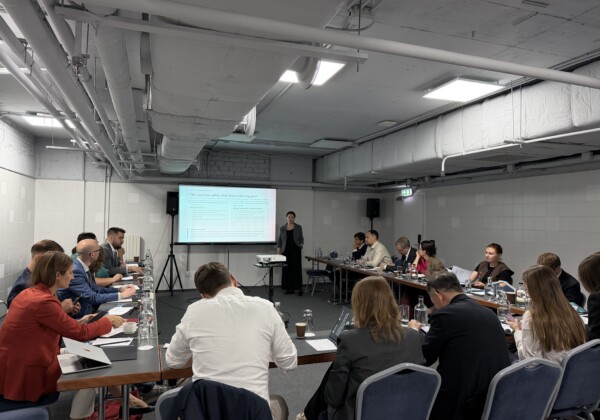
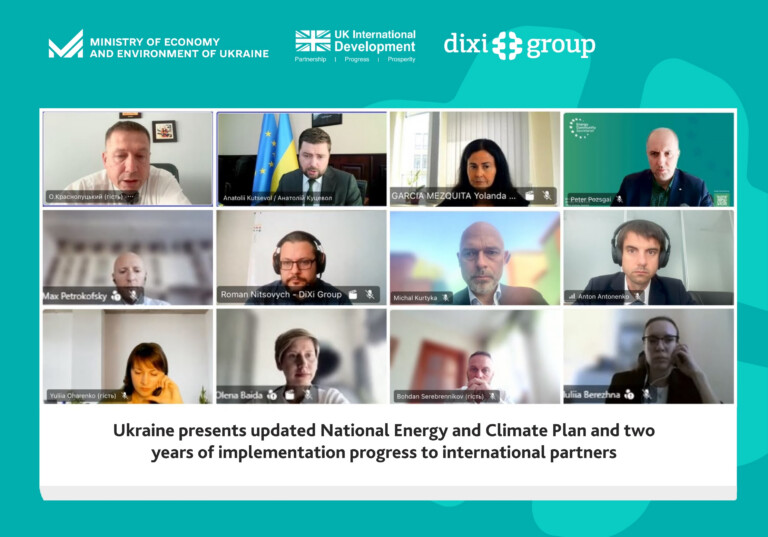
Ukraine presented its updated National Energy and Climate Plan (NECP), adopted by the government in June 2026, to international partners at a meeting of the High-Level Advisory Group (HLAG) on 8 September. Participants included the Ministry of Economy and Environment of Ukraine, the Ministry of Energy, the European Commission, the Energy Community Secretariat, the British Embassy and other international partners.
Ukraine stands out among the Contracting Parties of the Energy Community, having revised the document after just the first years of implementation. In that time, a whole delivery infrastructure has taken shape around the Plan. The Green Transition Office is operational, the Ministry of Economy and Environment has a dedicated unit coordinating implementation, and a digital system now tracks how the Plan is being delivered. Ukraine was also among the first to submit its integrated national energy and climate progress report. The document itself, however, remains a framework that has yet to be filled with real investment, as the Ministry points out.
“We have laid the foundation for delivering the NECP. The next task is to fill it with concrete projects and investments that will secure the green transition, modernise the economy and meet our European integration objectives,” said Oleksandr Krasnolutskyi, Deputy Minister of Economy and Environment of Ukraine.
The 2030 targets were refined by experts from the Institute for Economics and Forecasting of the National Academy of Sciences of Ukraine, working with an upgraded TIMES-Ukraine model that reflects revised assumptions on GDP, demographics, war damage and global energy prices. Greenhouse gas emissions are to fall by more than 65% against 1990 levels and methane emissions by 30% against 2020 levels. Renewables are expected to account for 27% of gross final energy consumption and 29.4% of electricity generation, while total energy consumption is capped at under 59.4 Million tonnes of oil equivalent of primary and under 38.1 Mtoe of final energy under the WAM scenario.
Decarbonisation policies on just transition and climate adaptation have been significantly expanded, and 12 new measures added to cut greenhouse gas emissions, among them carbon credits, higher fuel excise, afforestation and climate-smart agriculture. Five policies have matured from WAM to WEM, including the Global Methane Pledge action plan and just transition implementation. On renewables, the Plan introduces new frameworks for offshore wind, biomethane incentives and Renewables Acceleration Areas with simplified permitting, along with sustainability criteria for biofuels. In energy efficiency, NZEB requirements and several thermal modernisation financing programmes have also moved from WAM to WEM, and primary and final energy consumption trajectories have been revised to account for wartime damage, demographic change and updated economic assumptions.
Energy security saw a comprehensive revision of cybersecurity policy, updated programmes for spent nuclear fuel and radioactive waste management, and a new acquis harmonisation measure incorporating the EU network code on energy emergencies and restoration.
The internal energy market dimension sees the largest expansion. In electricity, this covers auctions for new generation capacity and de-risking tools, battery energy storage systems, aggregation and microgrids. Gas sector reforms maturing to WEM include GTS and UGS conservation, balancing neutrality and DSO unbundling, alongside a clear path to reinforcing the independence of the National Energy and Utilities Regulatory Commission (NEURC).
Investment needs under the WAM (with additional measures) scenario now stand at some €6 billion a year, down from the previous version of the Plan because of a shorter planning horizon, actual infrastructure damage and revised macro-financial assumptions. Even so, that figure is on a par with annual capital investment across the entire economy before the invasion. Ukraine has no intention of spending it on rebuilding old systems, stressed Anatolii Kutsevol, Deputy Minister of Energy of Ukraine for European Integration, adding that what replaces them must be resilient and energy efficient.
For the European Commission, the updated Plan matters above all as part of the EU accession negotiations. Yolanda Garcia Mezquita of the Directorate-General for Energy pointed to Ukraine’s stronger institutional capacity, the clear allocation of responsibilities, formal procedures for preparing the Plan and more transparent engagement with stakeholders. The document already reflects recommendations that came out of screening, among them broader measures on renewables, heating and cooling, and more structured consultation. The Commission sees the next step as the move from planning to delivery, and the transparency of that work, she said, gives international institutions and private investors confidence that the reforms are real and the risks understood and manageable.
“Ukraine is turning its commitments into concrete rules that will be implemented, showing that it is not only managing a crisis but also shaping the long-term European future of its energy sector,” she said.
The tools to track that delivery are already in place. The government has approved a single procedure for preparing the Plan and reporting on progress, and every NECP policy and measure has been broken down into specific tasks with agreed milestones over five years. The Ministry of Economy and Environment can follow the status of each task through an online platform that connects officials across the relevant authorities, with some of the data publicly available. The platform is updated monthly. Ukraine’s British partners, who support this work, single out the focus on monitoring as one of the updated Plan’s real strengths.
“The updated NECP not only helps Ukraine fulfil its green commitments on the path to EU accession, but is also important for economic stability, resilience and the decentralisation of the energy system, and, consequently, for the country’s sustainable recovery, which we are committed to supporting. Its emphasis on monitoring, accountability and independent assessment is particularly important: these elements are necessary to safeguard public policies, to inform development partners and Ukrainian citizens, and to ensure the effective implementation of decisions across all sectors,” said Max Petrokofsky, Head of Recovery, British Embassy Kyiv.
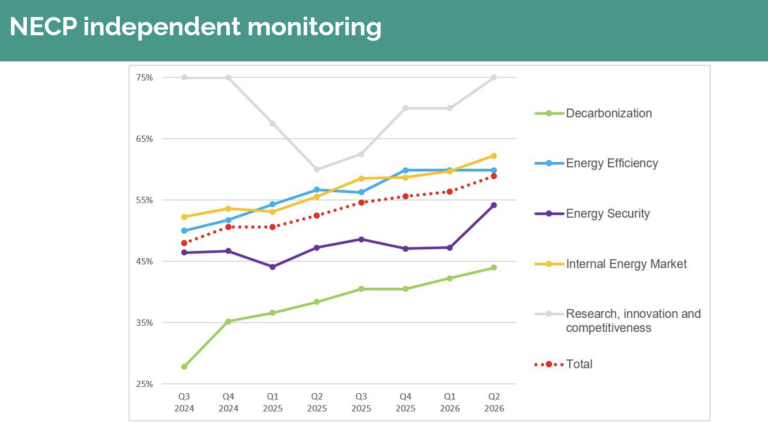
Alongside the government’s reporting system, the Plan is independently monitored by a team of DiXi Group experts. The war undoubtedly makes implementation more difficult; however, a separate analysis shows that only 7% of policies and measures cannot be implemented because of the war. Almost half can be implemented regardless of developments on the front line, as they primarily concern regulation and legislation. Progress is visible across all five NECP dimensions, and it was this trend that the closing assessment focused on.
“The updated Plan responds to the challenges posed by the war, the needs of recovery and Ukraine’s EU integration. In addition to new targets and measures, it draws on implementation experience: according to DiXi Group’s independent monitoring, the composite NECP implementation score increased from 48% to 59% over two years. The government’s establishment of a reporting system is also an important step, strengthening accountability for the implementation of specific measures. The key task now is to maintain the momentum and turn the NECP into an effective investment roadmap,” concluded Roman Nitsovych, Research Director at DiXi Group.
Background
The National Energy and Climate Plan is a strategic document that aligns environmental, energy and economic policy to support Ukraine’s sustainable development. It was drawn up in line with Regulation (EU) 2018/1999 and reflects best practice from EU member states, under Ukraine’s commitments as a Contracting Party of the Energy Community and in the course of its accession to the EU.
The Ministry of Economy and Environment of Ukraine coordinated the development and updating of the Plan, working with other executive authorities and the DiXi Group think tank. Delivery of the NECP is supported by the Green Transition Office, an independent advisory body under the Ministry, set up by DiXi Group to support reforms in green energy, climate policy and sustainable development.