According to the Aggregated Gas Storage Inventory (AGSI), the pan-European gas storage platform, as published on the Energy Map portal, Ukraine’s underground gas storage (UGS) facilities held 14.75 bcm of natural gas as of the end of the gas day on 31 August.
This volume exceeded the baseline target for gas storage levels at the beginning of the heating season set by the Ministry of Energy at 14.6 bcm. The target was reached one month ahead of schedule.
The total volume of stored gas includes 4.6 bcm of long-term storage gas. Of this amount, 942 mcm is gas that, in 2022–2025, Ukrtransgaz transferred to its fixed assets and which serves as cushion gas, as well as 3.7 bcm of working gas stored in UGS facilities to compensate for the shortage of cushion gas. The data are based on Ukrtransgaz’s 2025 financial statements.
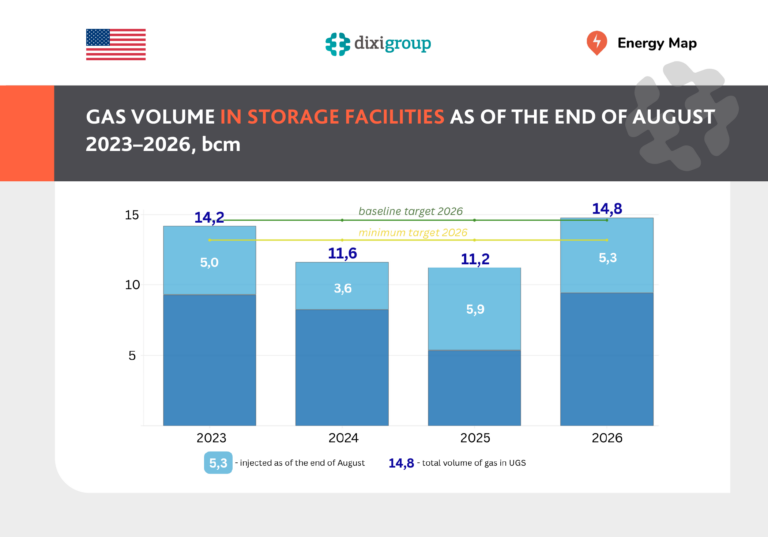
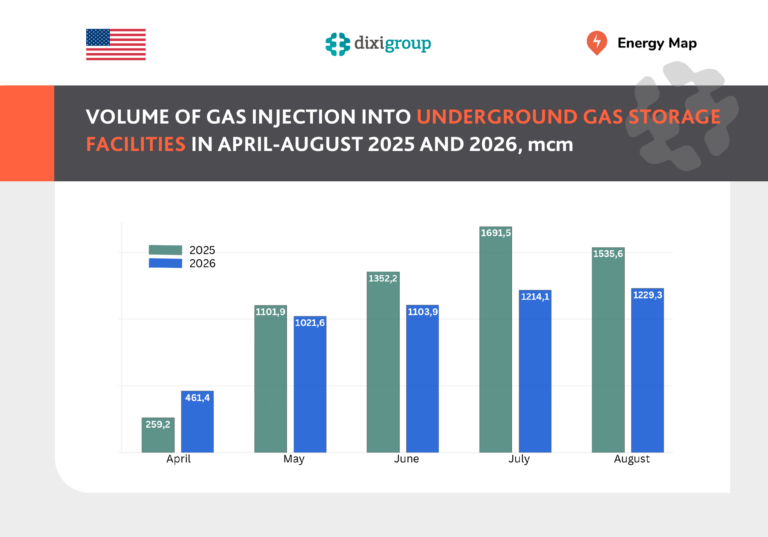
In August, 1.23 bcm of gas was injected into UGS facilities, which was 1.2% more than in July, but 19.9% less than in August 2025. Gas injection volumes in July 2026 amounted to 1.21 bcm, which was 28.2% lower than in July 2025.
The average daily injection rate in August was 39.7 mcm. This was 29.4% higher than the average for the 2026 injection season (30.6 mcm) and 0.7% higher than the average for the 2025 season (39.4 mcm).
For the purposes of calculating average daily figures, the beginning of the injection season is defined as the day after which net injection (injection minus withdrawal) exceeds 1 mcm per day for three consecutive days, with the positive value maintained over the following seven days. Under this criterion, the 2026 injection season began on 11 March, while the 2025 season lasted from 17 April to 3 November.
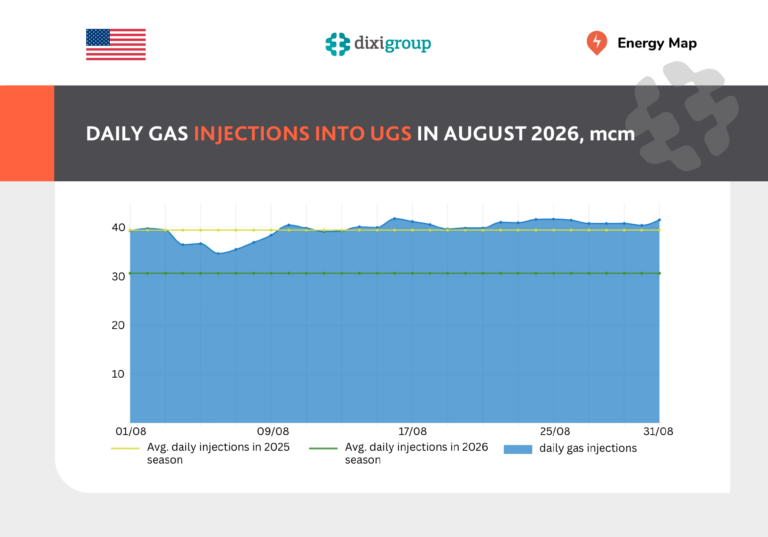
Daily injection volumes are affected by regular Russian attacks, which destroy critical equipment at gas production facilities. In particular, part of gas production was lost following attacks on Naftogaz Group’s assets on 7 and 9 August.
* To convert figures from energy units (TWh, GWh) into volume units (bcm, mcm), a conversion factor of 10.595 kWh/cubic metre was used. For days for which the data administrator did not provide injection data for the gas day, linear interpolation was used (the arithmetic mean of the injection figures for the days immediately preceding and following the date for which data was unavailable).
The Energy Sector Transparency (EST) project supports key U.S. administration priorities by advancing its energy interests and expanding opportunities for American companies in Ukraine’s energy sector. By strengthening transparency and anti-corruption safeguards, the project helps foster a more predictable, rules-based environment that can support fair competition and encourage investment. Through support for market-oriented reforms and stronger data systems, EST contributes to U.S. economic interests while reinforcing U.S. leadership in the global energy sector.
This report is made possible by the generous support of the United States Government. The contents are the responsibility of DiXi Group and do not necessarily reflect the views of the United States Government.