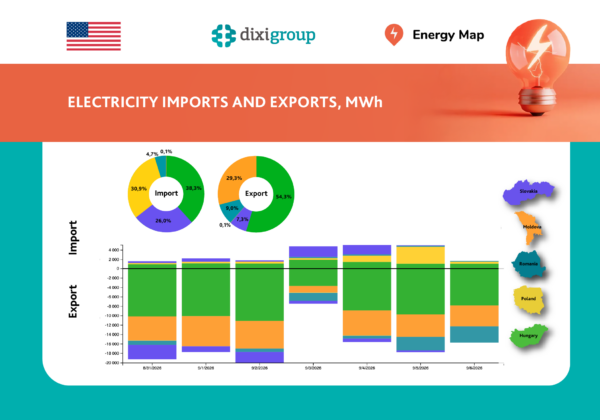
According to Energy Map, Ukraine’s electricity exports increased by 17% compared to the previous week during 7-13 September, reaching 132.2 GWh, while imports declined by 26% to 16.6 GWh. As a result, electricity exports exceeded imports by a factor of eight.
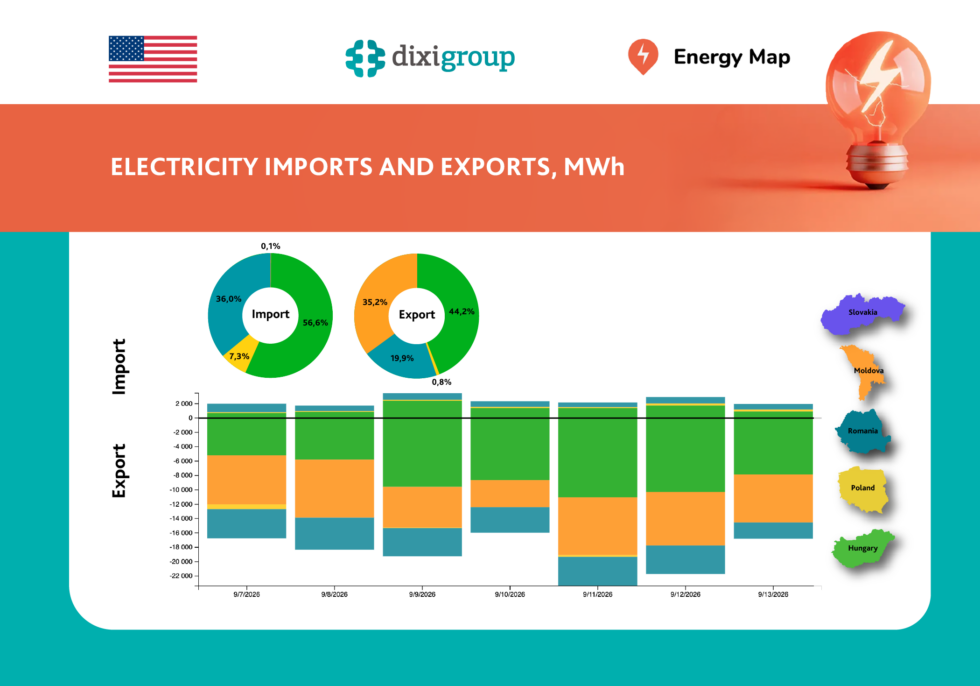
Comfortable weather conditions and lower electricity demand allowed the power system to maintain a relatively stable surplus balance and remain a net exporter of electricity. The decline in consumption observed in recent weeks is linked not only to weather conditions, but also to the impact of russian attacks on industrial facilities and infrastructure.
Import structure by country*:
- Hungary – 9.4 GWh (56.6%);
- Romania – 6.0 GWh (36.0%);
- Poland – 1.2 GWh (7.3%);
- Moldova – 0.01 GWh (<0.1%).
Compared to the previous week, electricity imports from Romania increased by a factor of 5.7, while imports from Hungary rose by 9%. At the same time, imports from Poland declined by 82%, and those from Moldova fell by 68% from relatively low volumes. Electricity flows with Slovakia came to complete halt, with no exports or imports recorded throughout the week on this interconnection.
Export structure by country*:
- Hungary – 58.4 GWh (44.2%);
- Moldova – 46.5 GWh (35.2%);
- Romania – 26.3 GWh (19.9%);
- Poland – 1.0 GWh (0.8%).
Compared to the previous week, electricity exports to Romania increased 2.6 – fold, while exports to Poland rose 6.7 – fold, albeit from relatively low volumes. Exports to Moldova increased by 40%. Exports to Hungary declined slightly, by 5%, but Hungary remained the largest export destination. Electricity exports to Slovakia remained at zero.
Daily electricity export volumes ranged from 16.0 to 23.4 GWh, while imports ranged from 1.7 to 3.5 GWh. The export-to-import ratio remained in the range of 5.5 to 10.8.
*The total may differ due to rounding.
The Energy Sector Transparency (EST) project supports key U.S. administration priorities by advancing its energy interests and expanding opportunities for American companies in Ukraine’s energy sector. By strengthening transparency and anti-corruption safeguards, the project helps foster a more predictable, rules-based environment that can support fair competition and encourage investment. Through support for market-oriented reforms and stronger data systems, EST contributes to U.S. economic interests while reinforcing U.S. leadership in the global energy sector.
This report is made possible by the generous support of the United States Government. The contents are the responsibility of DiXi Group and do not necessarily reflect the views of the United States Government.