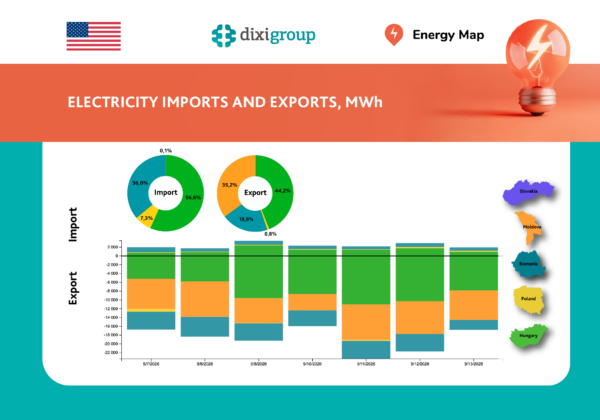
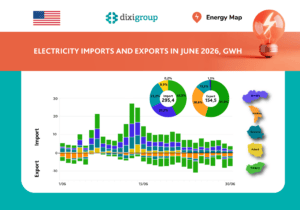
According to Energy Map, in June 2026 Ukraine reduced electricity imports by 26% compared to May, to 295.4 GWh. At the same time, exports surged by 64% to 154.5 GWh, reaching their highest monthly level since October 2025. Despite this significant boost in exports, Ukraine remained a net importer of electricity, with imports exceeding exports by a factor of 1.9.
The improvement in cross-border trade figures was primarily driven by seasonal factors. Moderate temperatures throughout most of the month restrained electricity consumption, while sunny weather supported strong solar generation.Additionally, the power system’s balance improved following the return to service of a nuclear power unit after scheduled maintenance. As a result, domestic generation combined with commercial imports was sufficient to meet consumer demand, while surplus electricity generated during certain periods was exported.
However, the situation changed noticeably toward the end of June. A heatwave affecting most European countries, including Ukraine, led to a sharp increase in electricity consumption due to widespread use of air conditioning. At the same time, stronger demand across European markets reduced electricity import opportunities, as market prices rose significantly.
As a result, on 30 June, from 17:00 to 22:00, hourly outage schedules for the public and capacity limitation schedules for industry and businesses were forced to be applied in all regions of Ukraine to maintain balance in the system. This marked the first instance of consumption restrictions returning since April of this year.
The security situation remained challenging. In particular, massive missile and drone attacks launched by russia on 2 and 15 June caused damage to energy infrastructure and disrupted electricity supply in Kyiv and several other regions.
Import structure by country:
- Hungary – 125.6 GWh (42.5%);
- Slovakia -74.4 GWh (25.2%);
- Romania – 68.6 GWh (23.2%);
- Poland – 26.1 GWh (8.9%);
- Moldova – 0.7 GWh (0.2%).
Compared to May, electricity imports declined across most interconnection directions. The sharpest decreases were recorded for imports from Poland (down 71%), Hungary (down 39%), and Romania (down 30%). At the same time, imports from Slovakia increased 79-fold. However, this was primarily due to a low comparison base, as electricity imports via this interconnection took place on only one day in May.
On a year-over-year basis, imports increased by 45% compared to June 2025, when Ukraine imported 203.9 GWh of electricity.
Export structure by country:
- Hungary – 84.7 GWh (54.8%);
- Moldova – 47.5 GWh (30.8%);
- Romania – 20.4 GWh (13.2%);
- Slovakia -1.9 GWh (1.2%).
There were no supplies to Poland during the month. Compared to May, exports to Moldova increased 2.6-fold, to Hungary – by 41%, and to Romania – by 26%, while exports to Slovakia were restored after an absence of supplies in May.
On a year-over-year basis, exports decreased by 35% compared to June 2025.
Use of interconnector capacity for imports
According to the latest publicly available information for the winter 2025/2026 period, the nominal electricity import capacity from EU countries to Ukraine and Moldova amounts to 2.45 GW. Of this, approximately 2.1 GW was available for commercial electricity imports to Ukraine after accounting for Moldova’s import requirements. At the same time, the permitted import capacity allocated to each country is dynamic and may be revised on a monthly or even weekly basis. These revisions are carried out by the TSCNET Regional Coordination Centre in cooperation with the transmission system operators of the countries participating in the Eastern Europe Capacity Calculation Region (EE CCR), taking into account the operational security conditions of the interconnected power systems within the EE CCR.
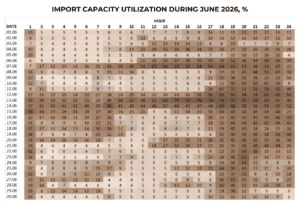
Using the latest publicly available information on the nominal maximum commercial import capacity for Ukraine (2.1 GW), the average utilization level in June amounted to 19.5%. The peak interconnector loading of 76.1% was recorded on 13 June during the 15:00-16:00 hour, while the minimum level stood at 3.5% on 22 June (02:00-03:00) and on 23 June (03:00-06:00).
At the same time, the actual allocated import capacity was revised throughout June depending on the operational situation in the power systems. Therefore, the real utilization level of the available transmission capacity could have been higher.
Thus, in June, the Ukrainian power system demonstrated a relatively balanced operating model. Increased electricity generation from solar power plants, the return to service of a nuclear power unit, and moderate weather conditions significantly reduced the need for imports and enabled an increase in electricity exports. At the same time, the final days of the month showed that this balance remains unstable. A heatwave simultaneously affecting Ukraine and EU countries, the seasonal maintenance campaign, the consequences of russian attacks, and limited import capacity led to the reintroduction of of consumption restrictions.
The EST project supports key U.S. administration priorities by advancing its energy interests and expanding opportunities for American companies in Ukraine’s energy sector. By strengthening transparency and anti-corruption safeguards, the project helps foster a more predictable, rules-based environment that can support fair competition and encourage investment. Through support for market-oriented reforms and stronger data systems, EST contributes to U.S. economic interests while reinforcing U.S. leadership in the global energy sector.
This report is made possible by the generous support of the United States Government. The contents are the responsibility of DiXi Group and do not necessarily reflect the views of the United States Government.