
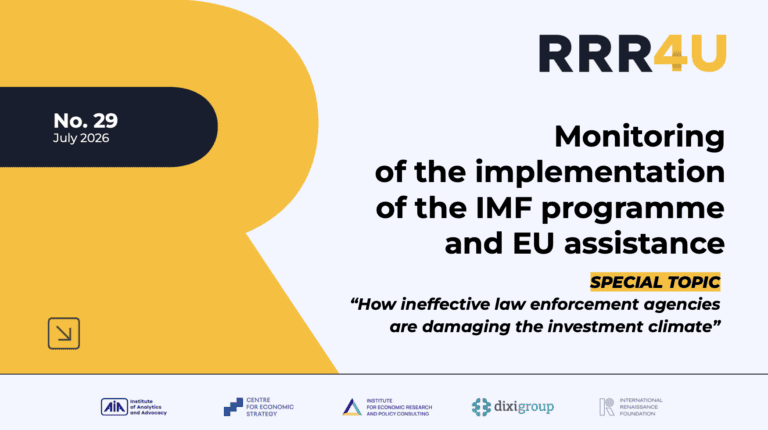
Ukraine has received $3.39 bn from the World Bank under the Development Policy Operation (DPO-1 2026) support facility. Twelve other commitments have also been set out for Ukraine: fulfilling these will enable the country to receive a further $1 billion from the World Bank under DPO-2.
On 20 July 2026, the IMF Executive Board approved the first review of the Extended Fund Facility programme. Ukraine received a second disbursement of approximately $690 million from the Fund. The IMF press release states that, overall, programme implementation has been satisfactory, although the Fund’s experts noted that reform implementation has slowed. The updated Memorandum with the IMF contains eight new structural benchmarks, seven of which are fiscal.
On July 30, the Council of the EU approved amendments to the Ukraine Plan, paving the way for the mobilisation of additional funding of over €8 billion in 2026. Following the update to the Ukraine Plan, the main challenge is not only to launch new reforms but also to fulfil existing commitments in a timely manner, upon which further EU funding depends.
Requirements for Receiving Assistance from the World Bank
World Bank’s Development Policy Support Operation – new tasks
- In July, Ukraine received $3.39 billion from the World Bank under the first component of the Development Policy Operation (DPO-1 2026), amounting to $3.39 billion.
- The second component of the DPO loan, amounting to $1 billion, requires the fulfilment of commitments by the end of 2026 or, at the latest, by the end of Q1 2027: 12 comprehensive tasks have been identified, some of which involve continuing the implementation of reforms that were adopted in order to secure the first loan.
- The three main areas of reform are:
- Private sector financing and investment
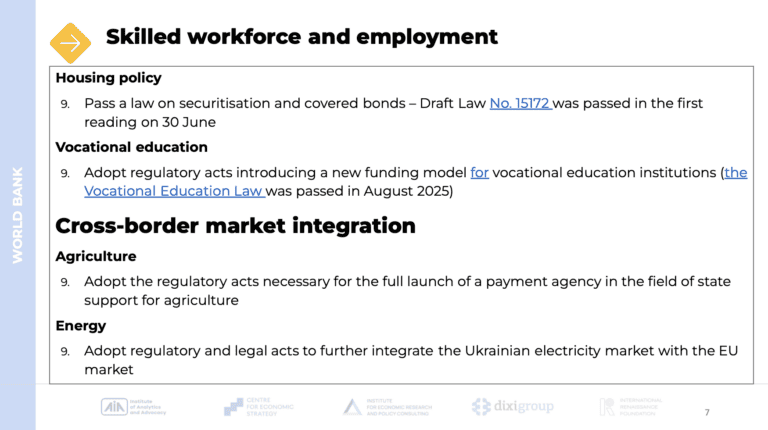
- Skilled workforce and employment
- Cross-border market integration
- The commitments include the adoption of legislation and regulations that must comply with EU law.
Private sector financing and investment
Public-Private Partnership (PPP)
- Adopt the regulatory and legal acts necessary for the implementation of the law on public-private partnerships: effectively implement the adopted PPP law (No. 4510-IX)
Access to finance and cross-border payments
- Adopt regulatory acts for the practical implementation of the laws on factoring and the National Development Agency: these laws were adopted for DPO-1 (No. 4466-IX and No.4622-IX respectively)
- Adopt the law on investment funds, draft law No. 13246 (registered on 1 May 2026; no opinion has yet been issued by the relevant committee)
- Adopt the law on property valuation – draft law No. 13435 (adopted in principle on 30 June)
- Adopt a law on joining the Single Euro Payments Area (SEPA): the bill has been carried over from DPO-1. The government’s draft bill has been withdrawn due to a change of government, although a parliamentary draft bill exists (corresponding to Indicator 4.9 of Ukraine’s Plan)
Privatisation and corporate governance of state-owned enterprises
- Announce a privatisation tender for at least one state-owned bank
- Adopt a law on small-scale privatisation
- Adopt regulatory acts and legislative amendments to strengthen corporate governance and the functioning of supervisory boards of state-owned enterprises
IMF
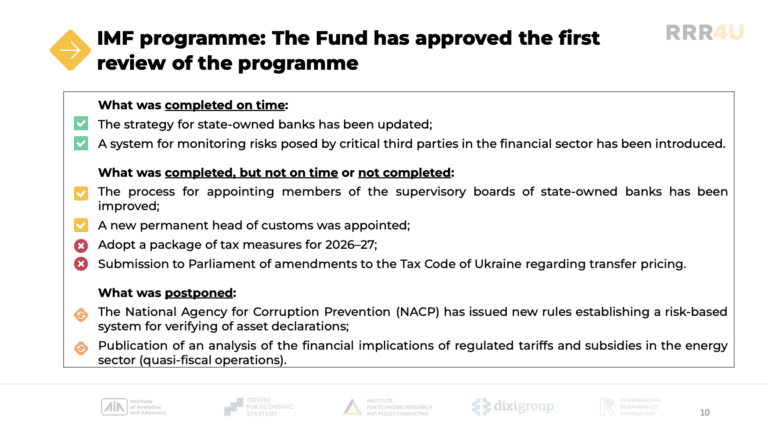
IMF programme: The Fund has approved the first review of the programme
- The IMF Executive Board has approved the first review of the Extended Fund Facility programme;
- Ukraine has received the second disbursement (approximately $690 million) under the programme.
From the IMF press release:
“Ukraine has maintained macroeconomic and financial stability despite Russia’s continuing war, a more challenging external environment, and risks remaining exceptionally high.
Program performance has been broadly satisfactory. Reform implementation has slowed, with several structural benchmarks completed with a delay or missed.”
IMF programme: The Fund has approved the first review of the programme
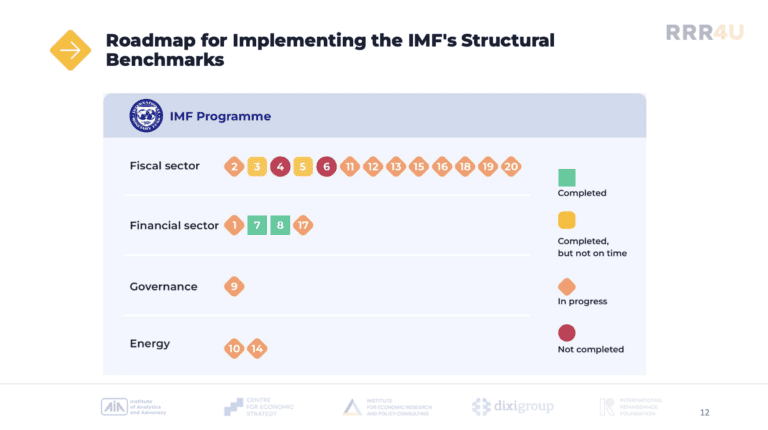
The updated Memorandum includes eight new structural benchmarks:
- Refrain from assigning any new ad-hoc spending obligations to the Pension Fund of Ukraine (continuous);
- Enact legislation to introduce a tax on income earned from digital platforms and to remove the tax exemption on low-value imports through postal shipments (end of July 2026);
- Submit to Parliament of amendments to the Tax Code, including to reform transfer pricing and interest limitation rules (end of August 2026);
- Submit amendments to the Tax Code to raise the threshold for unscheduled audits upon VAT refund requests and negative VAT liabilities from UAH 100,000 to UAH 1,000,000 (end of August 2026);
- Enact legislation to ensure National Energy and Utilities Regulatory Commission (NEURC) independence and improve nomination procedures (end of October 2026);
- Adoption of new organizational KPIs for the State Tax Service (end of December 2026);
- Submit anti-avoidance rules to prevent abuse of the Simplified Tax regime (end of December 2026);
- Enact the removal of the VAT exemption for ST and raise the VAT registration threshold, effective Jan 1, 2028 (end of April 2027).
EU
Ukraine Plan: more money → more reforms
- On July 30, the Council of the EU approved amendments to the Ukraine Plan, paving the way for the mobilisation of over €8 billion in additional funding in 2026 under the Ukraine Support Loan
- the updated Ukraine Plan includes 27 new reform milestones (of which 10 indicators will require the adoption of laws);
- the total number of indicators rises from 146 to 173;
- 34 existing indicators are being amended (for 12 indicators, deadlines are being extended; for 6 indicators, the description is being changed; and for 5 investment steps, the content or funding is being revised);
- all final reforms must be completed by the Q3 2027.
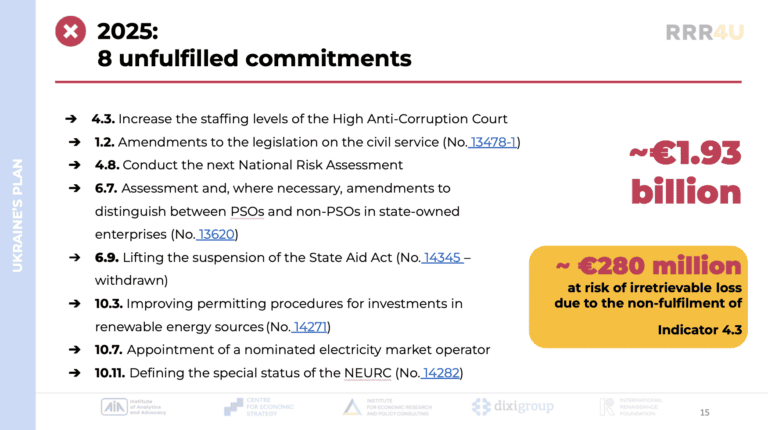
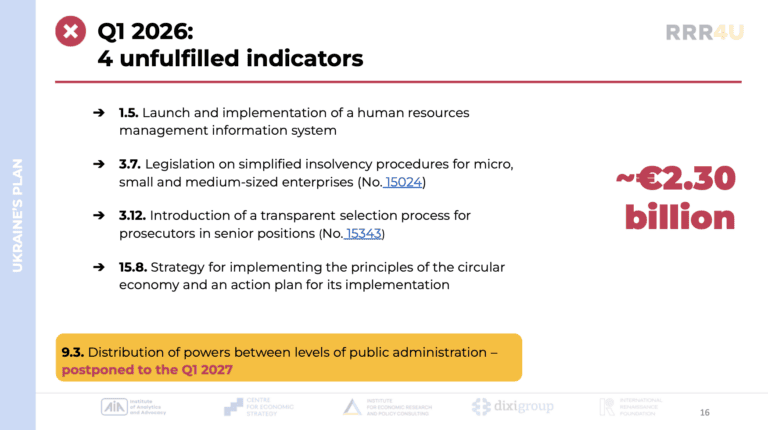
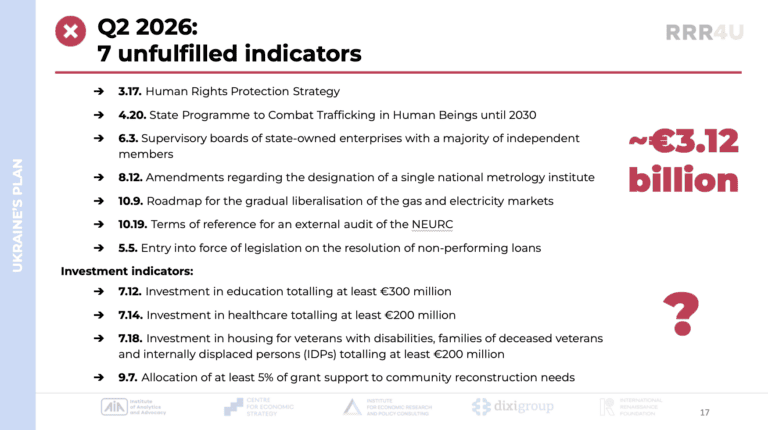
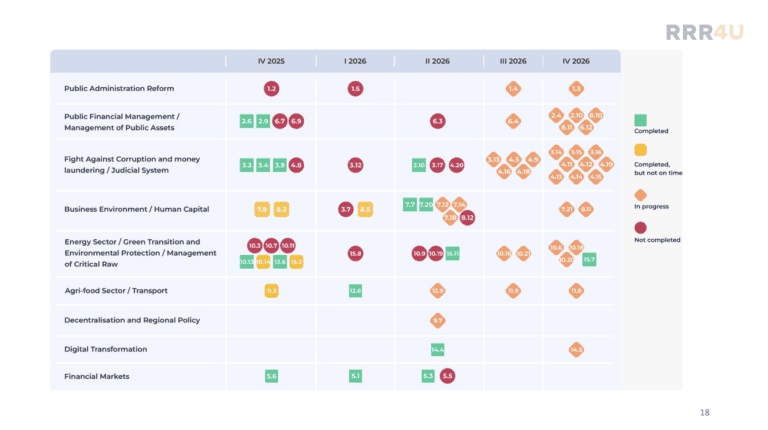
The backlog in indicator implementation continues to grow, potentially putting approximately €7.35 billion at risk.
Monitoring of Macro-Financial Assistance: Ukraine Support Loan
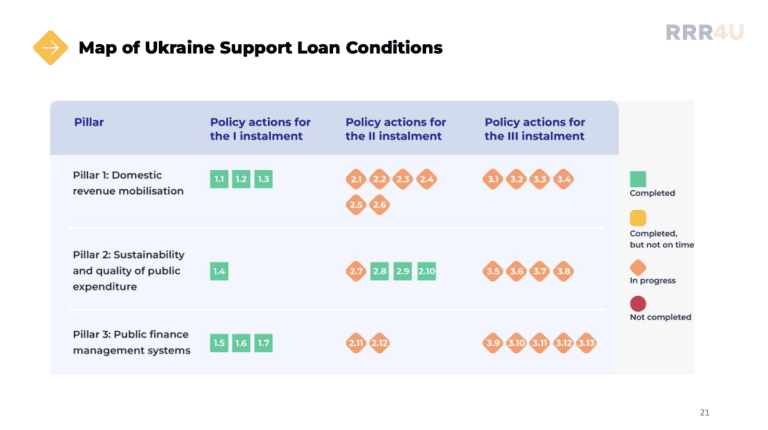
- Three out of the 12 conditions required to receive the second tranche of assistance have been met: the UPI IT concept, the Budget Declaration and expenditure reviews. However, work on some of the more complex conditions has not yet begun.
- Unfortunately, the President has still not signed the law introducing taxation of income earned via digital platforms — this is one of the 12 conditions required to receive the second tranche of assistance. We had previously marked this indicator as ‘fulfilled’, but have now reverted it to ‘in progress’.
- On 30 July, Ukraine received the second defence tranche from the EU under the Ukraine Support Loan, amounting to €3.47 billion. The funds were transferred to a special defence account. This tranche is not part of the macro-financial assistance, so no conditions had to be met to receive it.
SPECIAL TOPIC — «How ineffective law enforcement agencies damage the investment climate»
You can view the previous monitors on the website RRR4U
The monitoring was prepared with the support of the International Renaissance Foundation.
RRR4U (Resilience, Reconstruction and Relief for Ukraine) is a consortium of four Ukrainian civil society organisations: Centre for Economic Strategy, Institute for Economic Research and Policy Consulting, Institute of Analytics and Advocacy and DiXi Group.