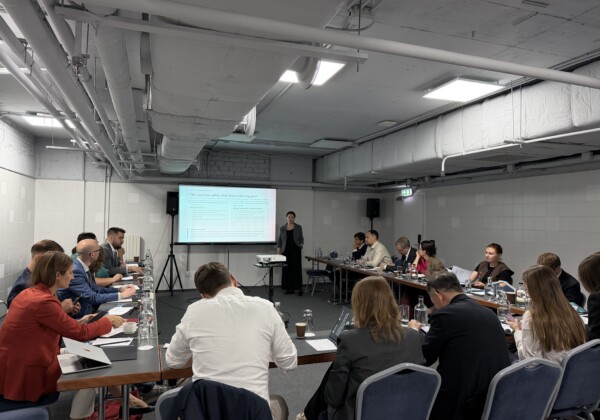
Faster decision-making and collaboration with local stakeholders should become key approaches for international institutions in their projects in Ukraine. The President of DiXi Group spoke about this at the event “What holds and what folds: economy of the future in a shaken world,” organized by the Open Society Foundations in Washington, D.C.
The expert noted that the regulatory procedures of international financial institutions (IFIs) can take too much time when making decisions regarding projects in Ukraine. Since the situation is constantly changing – decisions must be timely, so procedures need to be revised.
“Direct losses to Ukraine’s energy sector during the full-scale war exceed $24 billion – we will need even more to rebuild it in a more sustainable and green way. Long-term planning isn’t working right now: projects designed for 5–7 years are often ineffective. So the main approach to supporting Ukraine is flexibility – the ability to quickly adapt projects and procedures so they actually work to provide support,” the expert emphasized in her speech.
Olena Pavlenko noted that the “top-down” approach also needs to be revised in favor of greater horizontal interaction and cooperation with local stakeholders. It is necessary to take local specifics into account, communicate with local stakeholders to understand what is happening on the ground, and plan projects that are more focused on real needs.
According to her, the civil society sector should also be more integrated into consultations with IFIs and the implementation of local projects.
Among other things, the expert spoke about exchanging experiences with other countries on improving energy resilience in the face of external shocks.
“We are already conducting such consultations with countries in the Middle East. However, there are no universal approaches or advice for everyone: the key here is for international institutions to understand the local context,” she concluded.
The discussion was moderated by Eka Iakobishvili, Open Society Foundations. Among other panelists were Hela Cheikhrouhou, formerly WBG, HCR Advisory and Oleksandra Betliy, IER, Ukraine.
The visit was made possible thanks to the support of the International Renaissance Foundation as part of the “Advocating for Ukraine’s economic and financial resilience through reforms in the energy and adjacent sectors” project.