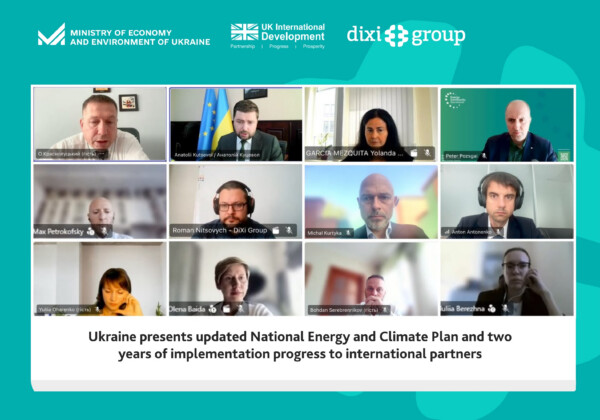
Ukraine has updated its National Energy and Climate Plan for the period to 2030 (NECP), reflecting new data, economic recovery needs, strengthened energy security priorities, and the country’s EU accession process. DiXi Group experts contributed to the revision of the document.
The updated NECP sets energy and climate targets for the coming years, along with the policies and measures required to achieve them. The Cabinet of Ministers of Ukraine approved the document at its meeting on 10 June 2026.
The Plan is aimed at fulfilling Ukraine’s international commitments and incorporates recommendations of the European Commission set out in Ukraine’s 2025 EU Enlargement Package Progress Report.
“The NECP is one of the key instruments for Ukraine’s green transformation. Its update allows Ukrainian policy to be synchronised with European approaches, and creates predictable conditions for investment in clean energy and low-carbon development,” said Oleksandr Krasnolutskyi, Deputy Minister of Economy, Environment and Agriculture of Ukraine.
Olena Pavlenko, President of the DiXi Group think tank, whose team contributed to the development and revision of the NECP, commented:
“The updated document is a synthesis of all energy and climate policies and strategies, including those adopted over the past year. The other part of the plan — modelling — is designed to show whether simultaneous implementation of all these policies is feasible and whether the targets are achievable. This is needed first and foremost by Ukraine itself, so that the NECP can gradually evolve into a list of investment projects that businesses can take up and implement.”
The NECP covers key areas of public policy across five dimensions: decarbonisation (including renewable energy), energy efficiency, energy security, the internal energy market, and research, innovation and competitiveness.
Following the document’s adoption in June 2024, Ukraine committed to updating the NECP in light of wartime realities, the fast-changing policy landscape, and the intensifying EU accession negotiations. The revised version reflects current challenges facing the energy sector, the need to restore critical infrastructure, and more clearly defined decarbonisation objectives — including the pathway to climate neutrality by 2050.
Key changes include:
- strengthened and new carbon pricing instruments;
- measures to reduce emissions of ozone-depleting substances and fluorinated greenhouse gases;
- an expanded just transition policy for coal regions;
- new measures in the land use, forestry, agriculture and waste sectors;
- updated and expanded renewable energy policies, including sustainability criteria for biofuels and an offshore wind energy development framework;
- revised primary and final energy consumption trajectories, accounting for the impacts of the war, demographic changes, and updated modelling.
The analytical section of the NECP has also been revised, including scenarios based on updated assumptions regarding economic development, demographics, infrastructure damage, foreign trade and global energy prices; modelling results using the TIMES-Ukraine tool have been aligned with the second Nationally Determined Contribution and long-term low-carbon development scenarios.
Implementation of the updated NECP will contribute to more effective coordination of public policy in the energy and climate sphere, mobilisation of international support and investment for specific projects, and decarbonisation of the economy in line with European approaches.
The full text of the NECP is available in Ukrainian.
The development of the document was made possible with the financial support of the UK Agency for International Development under the project “Implementation of the National Energy and Climate Ukraine Plan and establishment of the Green Economic Transition Office” implemented by DIXI GROUP NGO.