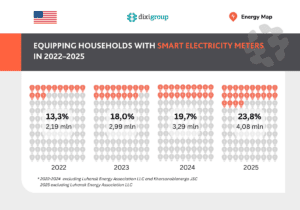
By the end of 2025, almost 24% of household electricity consumers in Ukraine had smart meters installed. The total number of such devices reached 4.1 million. The calculations are based on a unique dataset received in response to requests to the energy regulator (NEURC), systematized and published on the Energy Map portal.
For the first time, the regulator provided data for the Kherson region – 78,200 smart meters have been installed there, which is 32.1% of household consumers. Excluding this region, the level of equipment in the country is 23.7% (4.0 million meters).
At the same time, there is currently no data on what share of already installed smart meters meets the minimum functionality requirements defined by EU legislation (in particular Directive (EU) 2019/944 and the relevant European Commission recommendations). This means that the overall penetration rate of smart meters in households may not fully reflect the actual level of smart metering deployment in terms of compliance with European standards.
Installation rates are exceeding expectations. As of the end of 2024, 3.3 million meters had been installed, and under the investment programs approved by the National Energy and Utilities Regulatory Commission (NEURC), it was planned to add another 611,200 in 2025. However, the actual result exceeded the plan by more than 100,000 units, or 18.3%. This may be explained by the fact that, in addition to the planned installation of smart meters under the annual investment programs of distribution system operators (DSOs), consumers can independently order the installation of such meters at their own expense.
In 2026, DSOs plan to install an additional 741,700 smart meters (around 4.3% of the total number of residential consumers). The most ambitious plans are held by the SE “Rehionalni elektrychni merezhi”, which operates in the Lviv, Volyn, Vinnytsia, Dnipropetrovsk, and Donetsk regions, aiming to cover 19.2% of consumers. Among regional DSOs, Volyn region leads with a target of 9.1%.
What are smart meters?
A smart electricity meter is an electronic metering device that records electricity consumption over a certain period of time (for example, hourly) and automatically transmits this data to the DSO. Unlike conventional meters, it is part of an automated metering system (ACEMS) and enables data exchange between the consumer and DSO.
Such meters allow electricity consumption to be recorded across different time periods (for example, day/night), measure power system parameters (voltage, load), detect outages and other abnormal events, and store historical data on consumption and power quality. For consumers, this means fewer manual actions (no need to submit meter readings) and greater opportunities to monitor and optimize their electricity usage.
The replacement of meters is carried out by DSOs within their investment programs approved by the NEURC, but it is also available upon a consumer’s request on a commercial basis.
Regional leaders and outsiders in smart meter deployment
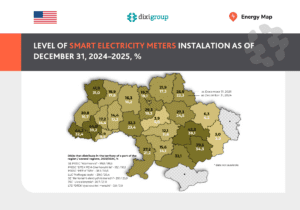
The highest level of smart meter installation was recorded in the Ivano-Frankivsk region – 44.9% (260,800 households). The Zakarpattia (44.3%), Dnipropetrovsk (42.3%), and Volyn (41.9%) regions also have levels above 40%.
In contrast, the lowest levels are recorded in the Kharkiv (6.3%), Cherkasy (3.9%), and Donetsk (3.0%) regions, where a total of only 128,900 meters have been installed.
It should be noted that for two DSOs, the level of smart meter deployment decreased in 2025 compared to the previous year: PJSC “Cherkasyoblenerho” (from 5.0% as of 31.12.2024 to 3.9% as of 31.12.2025) and JSC “Ukrzaliznytsia” (from 21.0% to 20.7%). As explained by the NEURC in response to a request, this was the result of a change in approach by the mentioned DSOs to determining the number of smart meters installed among household consumers, as part of the data collection equipment (meters, router-controllers) had failed.
Among the non-core DSOs – those that distribute electricity within part of a region or across several regions, the highest level of equipment remains in SE PRJSC “Atomservis” – 99.8% or 15,500 consumers, PRJSC “DTEK PEM-Enerhovuhillia” – 95.1% or 6,800 consumers and PRJSC “PEEM TSEK” – 38.1% or 40,300 consumers.
Dynamics of smart meter installation
In 2025, the fastest deployment of metering devices was recorded in the Kyiv (+54.8%, or +114,500 units), Kharkiv (+48.1%, or +25,600), Vinnytsia (+38.0%, or +70,200), and Zakarpattia (+37.5%, or +54,400) regions.
The slowest growth rates were observed in the Zhytomyr (+0.6%, or +600), Kirovohrad (+3.8%, or +1,900), and Rivne (+6.8%, or +5,400) regions. No new meters were installed in the Donetsk region during the year. Due to a change in the approach to meter accounting, PJSC “Cherkasyoblenerho” has negative dynamics (-22.5%).
Among non-core DSOs, the highest annual growth was demonstrated by SE “Rehionalni elektrychni merezhi” (+68.2%), PRJSC “PEEM TSEK” (+24.9%), and LLC “Naftogaz Teplo” (+11.2%). In contrast, other operators showed almost no deployment of smart meters, while JSC “Ukrzaliznytsia” recorded negative growth (-0.8%) due to a change in accounting methodology.
Over the period of full-scale war, the geographical factor has not been decisive. Regions close to the combat zone and border areas still demonstrated growth: in 2022-2025, the Kharkiv region increased by 93.1%, Chernihiv by 90.6%, and Zaporizhzhia by 80.6%.
The highest deployment rates over this period among regional DSOs were recorded in Volyn (+292%), Khmelnytskyi (+242%), and Zakarpattia (+190%) regions. The lowest rates were observed in Zhytomyr (14.9%), Rivne (16.4%), Kirovohrad (18.1%), and Cherkasy (18.5%) regions.
It is worth noting that the number of DSOs consumers is not a constant indicator.
In 2025, the largest annual increase in the number of consumers was recorded by SE “Rehionalni elektrychni merezhi” (+44.4%) and PRJSC “DTEK Kyivski Elektromerezhi” (+9.8%). At other DSOs, consumer growth did not exceed 3%. In some cases, the number of consumers decreased, including PRJSC “Kirovohradoblenerho” (-0.8%), PJSC “Cherkasyoblenerho” and JSC “Kharkivoblenerho” (-0.6%), JSC “Chernihivoblenerho” and JSC “Mykolaivoblenerho” (-0.4%), and PRJSC “PEEM TSEK” (-0.03%).
The Energy Sector Transparency Project (EST), implemented by DiXi Group, supports key U.S. administration priorities by advancing its energy interests and expanding opportunities for American companies in Ukraine’s energy sector. By strengthening transparency and anti-corruption safeguards, the project helps foster a more predictable, rules-based environment that can support fair competition and encourage investment. Through support for market-oriented reforms and stronger data systems, EST contributes to U.S. economic interests while reinforcing U.S. leadership in the global energy sector.
This report is made possible by the generous support of the United States Government. The contents are the responsibility of DiXi Group and do not necessarily reflect the views of the United States Government.