This paper examines the state of Ukraine’s energy system ahead of the 2025–2026 summer period, assesses key risks, and outlines potential scenarios for ensuring energy security in a wartime environment. The analysis is based on an attempt to apply the methodology of the European Network of Transmission System Operators for Electricity (ENTSO-E), which takes into account the principles of short-term and seasonal resource adequacy of power systems.
As the summer season approaches, Ukraine’s power system is in a state of recovery following a difficult winter, during which Russian strikes damaged 9 GW of generating capacity. At the same time, Ukraine is actively preparing for the 2026/2027 heating season by restoring damaged infrastructure, connecting distributed generation, and repairing grids. An open question remains regarding the restoration and protection of CHPs, which are not only critical facilities in winter but also essential for the system’s generation capacity in summer, especially during periods of scheduled maintenance of NPP units.
The start of the 2025–2026 winter season was marked by a capacity shortage, stressed equipment, constraints in transmission and distribution systems, and a critical dependence on electricity imports from the EU countries. At the same time, repairs to damaged power plants are ongoing, and new distributed generation capacity is being commissioned (the government’s goal is to restore 6 GW of capacity before the start of the heating season and to launch 1.5 GW of distributed generation by the end of the year). In this regard, there is optimism regarding an improvement in the availability of generating capacity over the summer compared to estimates made as of May as part of the preparation of the Summer Electricity Outlook 2026, which may influence the results of the optimistic and baseline scenarios.
Scenarios for the summer period:
The main risk and threat to energy security in Ukraine remains damage to energy infrastructure resulting from Russian attacks. This is why the application of the ENTSO-E methodology, which establishes approaches for assessing short-term and seasonal adequacy, is partially irrelevant, since in Ukraine, the indicators for the probability of load loss (LOLP) and the probability of no electricity supply (EENS) are the highest possible and, in some regions, approach 1 (or 100%). Therefore, the difference in the scenarios selected in this analytical document will lie not only in different assumptions regarding temperature regimes, but also in different estimates of damage to electrical equipment.
The previous two years differed significantly in both factors – the number of massive shelling attacks and average daily temperatures:
■ Summer 2024 – a significant number of massive attacks and maximum air temperatures exceeding +35°C across nearly the entire territory of Ukraine. According to DiXi Group estimates, due to damage to the energy infrastructure during the spring and summer of 2024, the percentage of hours with rolling outages was 65.6% in June, 78.2% in July, and 20.8% in August.
■ Summer 2025 – without a significant number of massive shelling attacks on energy infrastructure and with moderate weather (two heat waves – in July and August, with maximum temperatures not exceeding those of 2024). Outages were primarily emergency-related and affected specific regions (consequences of severe weather, damage to grid infrastructure following Russian attacks).
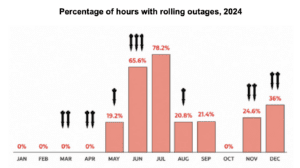
Source: DiXi Group estimates
According to the ENTSO-E methodology, the following indicators are used to assess seasonal adequacy:
■ LOLE (Loss of Load Expectation) – expected loss of load, expressed in hours during the period when available resources are insufficient to meet demand;
■ LOLP (Loss of Load Probability) – the probability of load loss, expressed as a percentage of the time when resources will be insufficient to meet demand;
■ EENS (Expected Energy Not Served) – the expected amount of energy that will not be supplied due to a resource shortage, expressed in GWh;
■ APM (Adequacy Probability Margin) – an indicator of the probability of adequacy (the sum of APM and LOLP equals 100%).
Basic assumptions for all scenarios:
■ Duration of the summer period: June 1 – August 31, 2026 (92 days, 2,208 hours); ■ Peak consumption hours: 6:00 PM–12:00 AM on weekdays, 6:00 PM–10:00 PM on weekends; ■ Off-peak hours: 1:00 AM–6:00 AM;
■ Maximum import capacity: 2.1 GW.
SCENARIO 1. NO NEW SHELLING OF THE POWER GRID UNDER MODERATE TEMPERATURE CONDITIONS
This scenario reflects the situation as of late April 2026, when some of the damaged equipment had been restored following the shelling. In Ukraine, thermal generation has historically been used to balance load schedules; however, as of spring 2026, it was significantly damaged, as was part of the hydro generation capacity, which had been partially restored after the shelling.
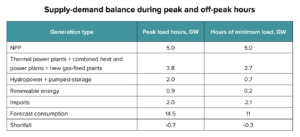
To assess the adequacy of generating capacity, a hypothetical summer scenario with a load of 14.5 GW was considered. This figure was selected as the upper limit of potential demand during specific hours of the summer period and used to verify the stability of the power system under increased consumption levels. During critical hours for the system, emergency assistance – imports (up to 250 MW) – may be utilized, and the reserve of flexible generation may be employed. Minor volumes can also be covered by pumped-storage hydropower (PSHP). However, the result obtained is not representative of all summer conditions. At lower load levels, specifically around 13 GW, the need to engage pumped-storage hydropower (PSHP) decreases significantly, and power balance can be maintained without a deficit. A deficit may arise if imports and flexible generation – thermal power plants (TPPs), combined heat and power plants (CHP), and PSHP – are unavailable.
The LOLP indicator, in the absence of new shelling and under moderate temperatures, will not exceed 5%. Expected load loss may occur over a period of 60–90 hours during the summer season, primarily during peak load hours, following a reduction in solar power generation and increased consumption. The expected amount of energy that will not be supplied (EENS) is up to 50 GWh.
In areas close to the front line or the border with Russia/Belarus, particularly in the Donetsk, Kharkiv, Sumy, Chernihiv, Zaporizhzhia, Kherson, Mykolaiv, and Odesa regions, the LOLP and ENS indicators will be significantly higher. To manage the shortage, NPC Ukrenergo will implement mandatory restrictions on end-user consumption.
Risks. Depending on the schedule of Energoatom’s maintenance campaign, more than two NPP units will be offline at any given time, meaning available NPP capacity may fall below 5 GW. Last year, the removal of nuclear generation for maintenance was partially offset by TPPs and CHPs. CHP plants accounted for 10–11% of the generation mix. As of May 2026, due to damage, there is insufficient restored CHP capacity in the system to ensure this level of production, and the operation of distributed gas-fired generation is currently difficult to predict for the purpose of compensating for the NPP units taken out for maintenance.
The scenario assumes that 0.9 GW of the load is covered by RES. On days with reduced RES efficiency, a reserve of transmission capacity for imports is maintained, as well as the ability to balance the system using pumped-storage hydropower plants (PSPPs), wind farms, and the engagement of Ukrenergo’s reserve maneuverable thermal generation capacities. Risks remain due to the inability to predict the availability of hydropower plants and pumped-storage hydropower plants, particularly reservoir levels during the summer period. The ability to utilize imports is limited by price caps and maximum transmission capacity. In the event of further market destabilization or price increases in EU countries (particularly due to domestic capacity shortages) exceeding 300 euros/MWh, commercial import volumes could decline significantly.
SCENARIO 2. NO NEW SHELLING OF THE POWER GRID, SIGNIFICANT INCREASE IN CONSUMPTION DUE TO RISING AVERAGE DAILY TEMPERATURES
Similar to the previous one, this scenario reflects the situation as of the end of April 2026, when some of the damaged equipment has been restored following the shelling. Consumption growth is assumed to be 1–1.3 GW relative to the moderate temperature load scenario. To calculate the number of days of extreme heat, the year 2024 was selected, as it featured temperature peaks more representative of this scenario.
The calculation assumes that imports will account for 80% of the permitted transmission capacity. This approach takes into account that imports may be economically inefficient (in particular due to the existence of price caps that limit the possibility of commercial imports if electricity prices in EU countries exceed the established price cap level) as well as the fact that in EU countries, under conditions of rising temperatures, the resource available for export may be limited.
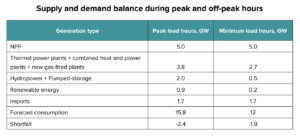
As average daily temperatures rise, rolling outages will be unavoidable; a deficit may occur even at night during periods of minimal demand.
In 2024, three heat waves (when temperatures remained above 30°C for several days) lasting from 4 to 9 days can be identified. The total number of days of abnormal heat assumed for this scenario is 20 days. On such days, the probability of load loss is close to 100%. Under clear skies, the situation will improve during the daytime due to the operation of solar power plants; therefore, to calculate the LOLP, we excluded 115 hours during the heatwave – from 11:00 a.m. to 4:00 p.m. on weekdays and from 10:00 a.m. to 6:00 p.m. on weekends. For all other days, it is assumed that load loss can only occur during peak load periods.
Under these assumptions, the LOLP is 38%. The expected load loss will occur during 846 hours between June 1 and August 31, 2026. The Adequacy(API) is 62%. The expected amount of energy not supplied (EENS) is ~1 TWh. Probability Index
The scenario leaves a margin of flexibility in thermal generation operations – assuming that 80% of installed capacity will operate during peak hours and 56% during off-peak hours. To minimize the amount of energy that will not be supplied, Ukrenergo may call on emergency assistance and bring online the maximum amount of available generation. Even under these conditions, a shortage during peak hours in hot weather cannot be avoided; however, it can be minimized during off-peak hours and the number of consumers subject to forced outages can be reduced. Additionally, to manage the shortage, Ukrenergo will implement hourly outage schedules.
Risks. For this scenario, similar to Scenario 1, risks remain associated with load loss during the simultaneous shutdown of three NPP units for maintenance. Risks also persist due to the current inability to forecast the availability of HPPs and PSPs, including the water levels in PSP reservoirs during the summer, as PSPs are a critical tool for system balancing. In this scenario, generation from HPPs and PSPs is lower compared to Scenario 1, due to the assumption that during prolonged heat waves, water levels in rivers and PSP reservoirs decrease.
SCENARIO 3. FURTHER DETERIORATION OF FLEXIBLE GENERATION AND GRID INFRASTRUCTURE, SIGNIFICANT GROWTH IN CONSUMPTION DUE TO RISING AVERAGE DAILY TEMPERATURES
Similar to the previous scenario, consumption growth is assumed to be 1–1.3 GW relative to Scenario 1. The decline in nuclear power generation is due to the inclusion in the scenario of cases of damage to transmission system equipment and the corresponding unloading of units. The scenario also accounts for new damage to thermal power plants, combined heat and power plants, and pumped-storage hydroelectric power plants.
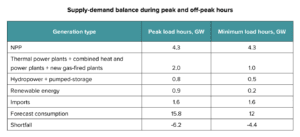
As in the previous scenario, the number of heatwave days is based on the 2024 estimate. The total number of extreme heatwave days assumed for this scenario is 20 days. On such days, the probability of load loss is close to 100%. The amount of energy that will not be supplied will depend on the scale and specific days of the shelling. It is objectively impossible to assess these events, so EENS is not estimated for this scenario.
On days with moderate temperatures, the power shortage will decrease; provided that prompt repairs are carried out on transformers and other transmission system equipment, and nuclear and thermal power plant units are brought back online, it will be possible to avoid shortages during daytime hours (thanks to solar power generation), on weekends, and at night. There is a risk of restrictions on imports due to damage to transmission capacity.
Ukrenergo will implement rolling outages schedules; however, the situation will vary by region depending on the nature of the damage, regional temperature conditions, and the operation of distributed generation. During peak load hours, up to four lines of outages may be implemented simultaneously.
This material was prepared by the NGO “DIXI GROUP” with the support of the International Renaissance Foundation within the framework of the project “Strengthening Ukraine’s Resilience in Energy”. This material reflects the authors’ views and does not necessarily reflect the views of the International Renaissance Foundation.