According to Energy Map data, in July, electricity imports to Ukraine decreased by 40.7% compared with the previous month, reaching 175.2 GWh while exports increased by 50.5%, reaching 232.5 GWh. As a result, for the first time in the past ten months, Ukraine became a net exporter of electricity, with a positive monthly electricity trade balance of 57.2 GWh.
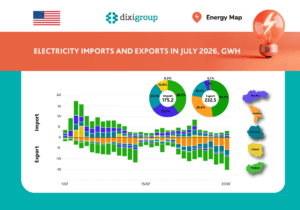
Throughout July, weather conditions remained the key factor influencing electricity trade, determining both electricity demand and the output of residential solar power systems. At the beginning of the month, the heatwave that had persisted since late June sustained high electricity demand due to intensive air conditioning use. The resulting capacity deficit in the power system led to the introduction of scheduled hourly outage plans for households and power consumption restrictions for businesses and industry on 1 July. No further demand restriction measures were imposed during the remainder of the month.
During the first seven days of July, the cumulative electricity trade balance remained negative at 43.3 GWh. Most electricity imports occurred during the evening peak demand hours (18:00-23:00), while exports were concentrated during nighttime and early morning hours. In addition, on 3 July, emergency outage schedules were introduced in several regions, and daily electricity imports reached 17.3 GWh – the highest level recorded during the month.
Later in the month, lower temperatures reduced electricity demand from the grid, decreasing the need for imports. As early as 8 July, the daily electricity trade balance turned positive, and from 11 July until the end of the month, daily electricity exports consistently exceeded imports. On 31 July, daily electricity exports reached 15.2 GWh, the highest daily volume recorded during the month.
Additional factors supporting export growth included stronger electricity demand in European countries due to hot weather, as well as Ukraine’s price advantage, with day-ahead market (DAM) prices remaining below those in neighboring Eastern European countries for almost the entire month of July.
Russia’s massive combined attacks on 2 and 6 July 2026 caused localized power outages, however, energy sector specialists managed to prevent widespread blackouts and restore the operation of consumption restriction schedules.
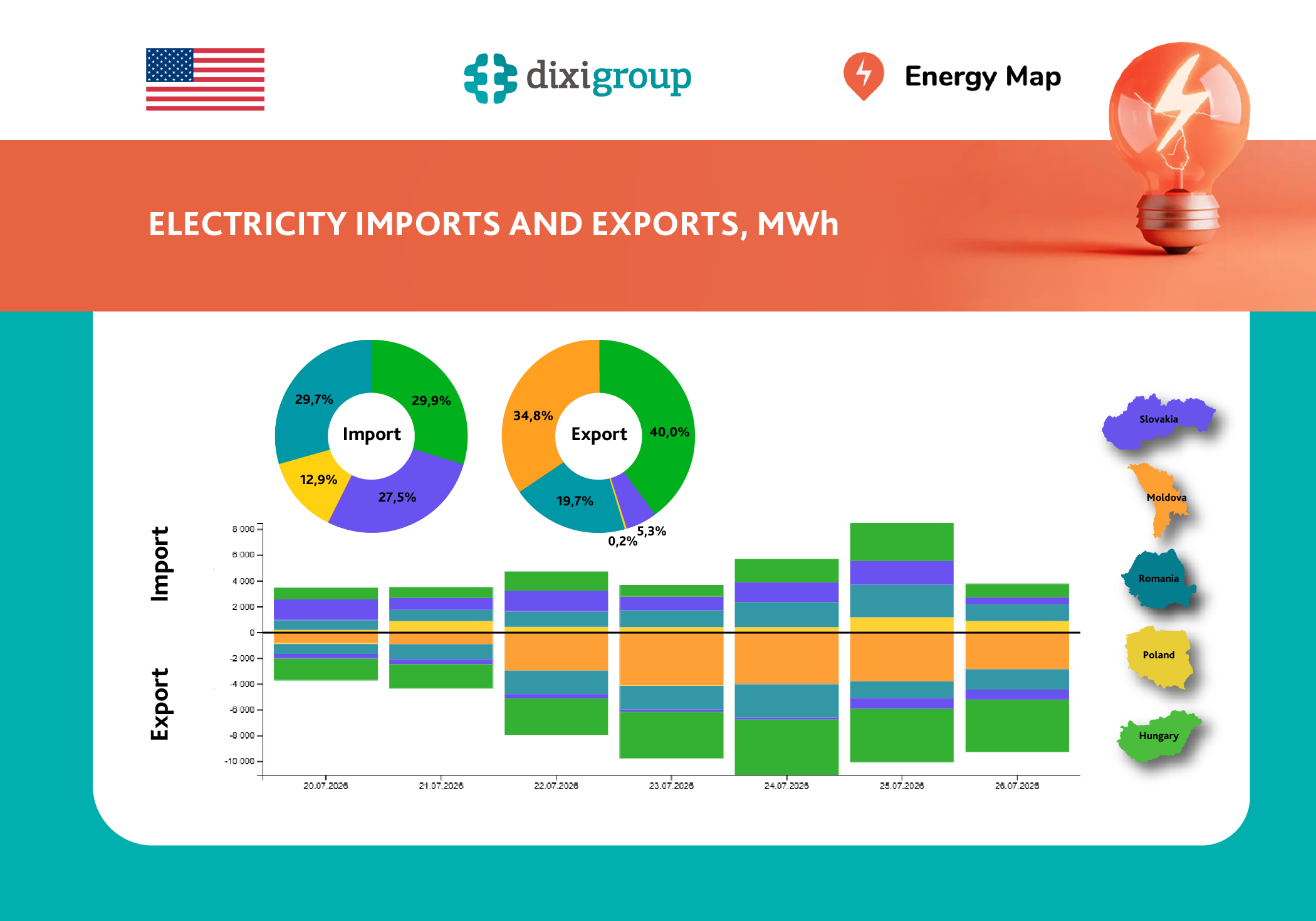
Import structure by country:
- Hungary – 69.2 GWh (39.5%);
- Slovakia – 45.2 GWh (25.8%);
- Romania – 42.0 GWh (23.9%);
- Poland – 18.5 GWh (10.6%);
- Moldova – 0.3 GWh (0.2%).
Compared with June 2026, electricity imports declined across all directions. The steepest decreases were recorded for imports from Moldova (-49.3%), Hungary (-44.9%), Slovakia (-39.2%), and Romania (-38.8%), while imports from Poland fell by 29.2%.
On a year-on-year basis, total electricity imports decreased by 32.0% compared with July 2025, when Ukraine imported 257.7 GWh.
Electricity exports took place daily, and starting from July 11, daily export volumes consistently exceeded imports through the end of the month.
Export structure by country:
- Hungary – 111.5 GWh (48.0%);
- Moldova – 68.9 GWh (29.6%);
- Romania – 38.7 GWh (16.6%);
- Slovakia – 11.8 GWh (5.1%);
- Poland – 1.6 GWh (0.7%).
Compared to June 2026, supplies increased across all directions. The largest growth was recorded for Slovakia (a 6.2-fold increase), followed by Romania (89.2%), Moldova (45.1%), and Hungary (31.6%).Additionally, supplies to Poland resumed on July 15, having been halted since November 2025.
Year-on-year, total export volume decreased by 17.6% compared to July 2025 (282.3 GWh).
Use of interconnector capacity for imports
According to the latest publicly available information for the winter 2025/2026 period, the nominal electricity import capacity from EU countries to Ukraine and Moldova amounts to 2.45 GW. Of this, approximately 2.1 GW was available for commercial electricity imports to Ukraine after accounting for Moldova’s import requirements. At the same time, the permitted import capacity allocated to each country is dynamic and may be revised on a monthly or even weekly basis. These adjustments are made following reviews conducted by the TSCNET Regional Coordination Centre in cooperation with transmission system operators of the countries participating in the Eastern Europe Capacity Calculation Region (EE CCR), depending on the operational security situation in the power systems of EE CCR countries.
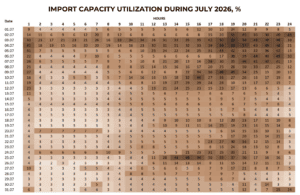
Based on the latest publicly available information on the maximum nominal commercial import capacity available to Ukraine (2.1 GW), the average utilization rate of this capacity in July amounted to 11.2%. The highest interconnector loading level of 60.4% was recorded on 3 July during 18:00-19:00, while the lowest level of 2.5% was observed on 26 July during the periods of 01:00-03:00 and 04:00-05:00.
The Energy Sector Transparency (EST) project supports key U.S. administration priorities by advancing its energy interests and expanding opportunities for American companies in Ukraine’s energy sector. By strengthening transparency and anti-corruption safeguards, the project helps foster a more predictable, rules-based environment that can support fair competition and encourage investment. Through support for market-oriented reforms and stronger data systems, EST contributes to U.S. economic interests while reinforcing U.S. leadership in the global energy sector.
This report is made possible by the generous support of the United States Government. The contents are the responsibility of DiXi Group and do not necessarily reflect the views of the United States Government.