
This analytical paper presents the results of an analysis of international approaches to identifying, assessing and monitoring green finance flows and will serve as a basis for developing recommendations on tracking trends in green finance mobilisation in Ukraine, in particular, tracking green finance in Ukraine’s banking sector.
Most of the approaches considered are based on two common principles, compliance with which is necessary for financial flows to be classified as green finance:
● confirmation of a positive contribution to the achievement of environmental and climate objectives;
● confirmation that there is no negative impact on the achievement of other environmental and climate objectives.
The wording of climate and environmental objectives varies, but in most cases they align with the objectives of the EU Taxonomy:
● mitigation of climate change;
● adaptation to the impacts of climate change;
● sustainable use and protection of water and marine resources;
● transition to a circular economy;
● pollution prevention and control;
● protection and restoration of biodiversity and ecosystems.
The level of detail and stringency of the requirements for demonstrating compliance with each of the principles can vary significantly between assessment methodologies and tools. For example, compliance with the second principle under the EU Taxonomy is achieved through the requirement to demonstrate compliance with the ‘do no significant harm’ principle, with clear criteria for each type of activity, whereas in the EBRD’s approach, it is achieved through demonstrating alignment with the objectives of the Paris Agreement and compliance with the EBRD’s Environmental and Social Policy, based on a detailed analysis of individual projects as part of environmental and social audits or other financing approval procedures. Another important element of the system for confirming the absence of adverse impacts may be various lists of activities whose financing is prohibited from being included in climate, green or sustainable finance.
Projects and programmes that comply with the underlying principles are classified, in whole or in part, as climate, green or sustainable finance, while the actual quantitative assessment of the proportion of funding directed towards achieving environmental objectives within the total project cost may be carried out in accordance with additional rules.
For financial flows that are fully classified as green investments, compliance criteria are applied. In this context, the analysis of compliance with the criteria is carried out for individual components of projects and programmes, rather than for the project or programme as a whole. The most detailed example of such criteria is the technical screening criteria of the EU Taxonomy, which are used to assess financing that makes a substantial contribution to the achievement of environmental objectives, and to assess compliance with the ‘do no significant harm’ principle. When using eligibility criteria, the share of green finance is defined as the proportion of the cost of green components relative to the total project cost and may reach 100 per cent.
For other projects and programmes that are partly aimed at achieving environmental objectives, different approaches are used.
RIO MARKERS were introduced in 1998 as a mechanism for tracking the contribution of international aid towards achieving the objectives of the Rio Conventions and continue to be used to monitor funding for measures to mitigate climate change, adapt to its impacts, conserve biodiversity and combat desertification. When collecting information on funding flows based on the Rio markers, a simple classification is used, whereby the contribution to the conventions’ objectives is assessed as principal, significant or not targeted. The Rio Markers-based approach is relatively straightforward and can be applied to various funding flows; however, it yields a qualitative assessment of funding, which may be rather subjective and based solely on general data on activities, rather than detailed quantitative monitoring of financial flows.
To move from qualitative assessments based on Rio markers to quantitative accounting of financial flows, various countries and organisations use coefficients for each of the three categories of Rio markers. In particular, data based on the Rio markers form the basis for reporting on financial assistance provided and received in accordance with commitments under the UN Framework Convention on Climate Change and the Paris Agreement. For activities where the climate aspect is a principal objective, a weighting of 100 per cent is used in most cases, while for activities where the climate aspect is a significant objective, most countries use weightings ranging from 30 per cent to 50 per cent. In addition to fixed coefficients, some countries use coefficients that are assessed for each activity or for a group of activities. The volume of climate finance calculated in this way will be lower than the total volume of official development assistance for climate purposes.
THE IFIS’ COMMON APPROACHES TO MONITORING CLIMATE FINANCE were developed to assess the progress made by multilateral development banks in supporting projects aimed at mitigating climate change and adapting to its impacts. The IFIs’ common approaches provide a detailed list of eligible activities and criteria for each type of activity. If these criteria are met, the funding may be counted as climate finance. Each financial institution may supplement this ‘positive list’ of projects and the corresponding eligibility criteria with additional criteria. For example, the EBRD supplements the list with a taxonomy of projects that contribute to nature conservation objectives, as well as a list of projects that contribute to other environmental objectives. It is important to note that the common approaches do not set specific quantitative requirements or characteristics for activities; rather, each IFI may define these based on individual standards or taxonomies of sustainable activities, taking into account its own needs and operating conditions in a particular region. Concerning adaptation to the impacts of climate change, the IFIs’ common methodology categorises activities according to the extent to which adaptation components feature in the project’s objectives and key goals. For activities whose primary objective is adaptation and that contribute to addressing the root causes of vulnerability to climate change, 100 per cent of the funding is counted as climate finance. For activities where adaptation is not a key objective but measures to adapt to the impacts of climate change are in place, as well as for activities with shared adaptation and development objectives, the proportion of climate finance will be less than 100 per cent. The common approaches set out only general methods for assessing adaptation funding in such cases, while the detailed methodologies are determined by each multilateral development bank.
CLIMATE FINANCE FOR DEVELOPMENT ASSISTANCE, on which the OECD collects information through a dedicated dataset, combines data on official development assistance with the Rio climate markers and data on other official financing flows, including climate finance from multilateral development banks. This dataset contains information both on climate finance for development assistance, which covers the total cost of projects and programmes, and on climate-specific finance, which includes only funding for a project component or a share of total funding directed exclusively towards supporting climate change mitigation and adaptation.
EU STRUCTURAL FUNDS are required to allocate a portion of their funds to environmental and climate initiatives and therefore also have procedures in place for assessing green finance. The contribution of funding towards achieving environmental and climate objectives is assessed using a methodology based on a list of types of activities, investments and funding programmes for each fund, and weighting factors. The weighting factors are determined using a financial flows assessment approach based on the Rio markers and can take the values 0% (no impact), 40% (significant objective) and 100% (principal objective). Weighting factors are set separately for climate objectives and other environmental objectives. A similar approach, with a slightly different classification of activity types, is also used in the Recovery and Resilience Facility.
THE EU TAXONOMY and other taxonomies of sustainable activities introduce a clear system for classifying economic activities, taking into account their impact on the achievement of environmental objectives. The EU Taxonomy was developed as one of the key instruments for implementing the European Green Deal and aims to redirect financial flows towards activities that align with the objectives of achieving climate neutrality, environmental sustainability, resource efficiency and the transition to a circular economy. Under the EU Taxonomy, an economic activity is recognised as environmentally sustainable only if it simultaneously meets four basic requirements:
● it makes a substantial contribution to at least one of the climate and environmental objectives;
● it must not cause significant harm to other objectives;
● compliance with minimum social safeguards;
● compliance with technical screening criteria.
A further argument in favour of the relevance of using the EU Taxonomy in the financial sector is the existence of established reporting approaches for relevant activities within both the banking sector and investment firms. Financial sector entities report on the proportion of assets in their investment portfolios that meet the requirements of the EU Taxonomy via the Green Asset Ratio, and also provide additional information on compliance with the EU Taxonomy. This lays the foundation for a detailed reporting system with objective parameters for identifying green and sustainable finance.
When analysing approaches to assessing green finance, a gradual shift can be observed from an initial qualitative assessment based on Rio markers towards clearer criteria and a quantitative assessment of green financial flows using weighting factors and taxonomies of sustainable activities. The EU Taxonomy and other taxonomies of sustainable activities provide the clearest method for classifying financial flows as green or sustainable finance, drawing on specific technical criteria and quantitative characteristics based on best practices and legislative requirements.
Effective tracking of green finance flows will require a combination of different approaches for different segments of financial flows, taking into account the existing architecture for data collection and assessment at the international level, as well as national policy priorities in the development of sustainable finance.
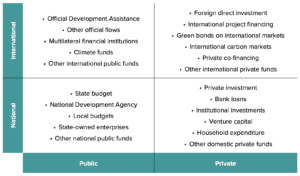
Tracking the green component of international financing from public sources can be based on existing mechanisms for which clear methodological approaches are already in place. Such green finance will include the portion of official development assistance assessed based on the Rio markers, as well as climate and other green finance from multilateral development banks. Data on the volume of climate finance for development assistance to Ukraine is already available for this segment – it has increased significantly since 2010, and averaged around $1 billion over the ten-year period 2014–2023. At the same time, due to differing methodological approaches, these figures include funding for climate-related purposes channelled through multilateral development banks; however, for bilateral official development assistance, they reflect the total value of projects with climate-related Rio markers, rather than only funding specifically allocated to climate objectives.
To track the green component among other sources of funding, it is important to introduce a national taxonomy that aligns with the EU Taxonomy, to gradually introduce disclosure requirements for specific types of organisations, and to create opportunities for any other organisations to use the taxonomy voluntarily. International experience shows that the taxonomy is the central element of the system for monitoring green and sustainable finance, as it provides a single classification framework for banks, investors and public authorities.
A national sustainable finance taxonomy, alongside appropriate assessment, monitoring and reporting procedures, will help to attract sustainable, green and climate finance for reconstruction and economic recovery.
DiXi Group is a member of the PAABS consortium. PAABS is funded by the Federal Ministry for the Environment, Climate Action, Nature Conservation and Nuclear Safety (BMUKN) under the International Climate Initiative (IKI), the project is supported and coordinated by the Deutsche Gesellschaft für Internationale Zusammenarbeit (GIZ) GmbH. PAABS stands for «Supporting Ukraine in the implementation of the Paris Agreement and adaptation to the impact of climate change in the Black Sea region».