For over four years now, the Russian Federation has been engaging in outright nuclear blackmail on Ukrainian territory – from the seizure of the Chornobyl NPP site on the first day of the full-scale war to ongoing attacks on energy infrastructure.
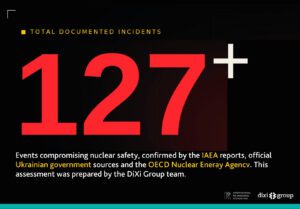
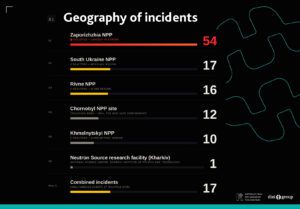
Ahead of the 40th anniversary of the Chornobyl nuclear disaster, DiXi Group experts have compiled a list of all recorded incidents at Ukraine’s nuclear facilities caused by Russian military actions since the start of the full-scale invasion. During this time, Russia has caused at least 127* incidents – confirmed by the IAEA reports, official Ukrainian government sources, and the OECD Nuclear Energy Agency – that have jeopardized nuclear and radiation safety.
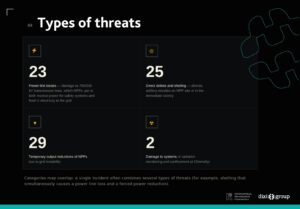
Over the course of four years of full-scale war, Russia has caused:
- 23 loss of external power supply to the NPPs – damage to the main power lines through which the NPPs receives power for its safety systems and supplies electricity to the grid;
- 25 direct strikes and attacks – by drones, artillery, and missiles – on industrial sites at the NPPs or in the immediate vicinity;
- 29 temporary reductions in NPPs output due to power grid instability resulting from damage;
- 2 instances of damage to radiation monitoring systems and New Safe Confinement (the protective structure over the destroyed Unit 4) at the Chornobyl NPP site.
54 incidents, i.e. 42.5% of total recorded number, occurred at the Zaporizhzhia NPP.
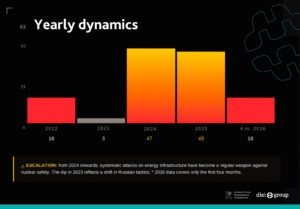
The frequency and intensity of Russian attacks increased in 2024, with 47 incidents recorded near and directly at Ukraine’s nuclear power plants, compared to 3 in 2023. In the first four months of this year alone, another 16 events have been recorded.
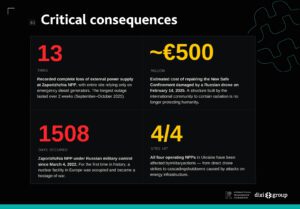
“Russia cynically disregards nuclear safety rules, the consequences of violating which the world witnessed forty years ago. Every attack on a substation close to a nuclear power plant, every direct hit is a risk that should not exist in the 21st century. At the same time, the world has not yet ceased cooperation with the Russian nuclear giant – Rosatom – which is significantly involved in Russia’s war crimes. It is this corporation that illegally operates the occupied Zaporizhzhia NPP, which – due to hostilities and deliberate violations of safety standards – has already been cut off from external power 13 times,” said Mykhailo Babiichuk, General Manager for Security and Resilience, DiXi Group.
DiXi Group has mapped Rosatom entities by threat type – ranging from the production of drone components to digital infrastructure and the illegal management of the occupied Zaporizhzhia NPP. Dozens of entities across six threat categories – none of which have yet been subject to the EU sanctions. Our think tank calls for sanctions against both legal entities and individuals associated with Rosatom, as it is not merely a nuclear corporation. It is a tool of the Kremlin, consisting of dozens of entities, each of which plays a role in supporting the Russian war machine.
*Incidents/events refer to: loss of connection between NPPs and power lines, strikes and shelling, temporary power output reductions due to strikes on the energy system, damage to radiation monitoring systems, etc. Some of such incidents may be classified according to the International Nuclear Event Scale (INES). Categories may overlap: a single incident often combines several types of threats (e.g., a strike that simultaneously causes a power line loss and a forced output reduction).
Preparation of the report was made possible due to the support of the International Renaissance Foundation under the project “Strengthening Ukraine’s Resilience in Energy” (SURE).