
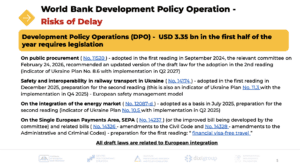
There is a risk of delays in receiving more than USD 3 bn from the World Bank. Parliament needs to adopt four EU-integration bills in order to unlock the Development Policy Operation (DPO).
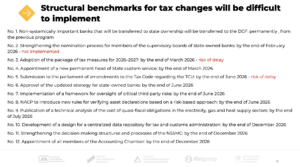
The IMF Executive Board has approved a new four-year programme for Ukraine amounting to USD 8.1 bn. The programme includes 12 structural benchmarks, with tax-related measures likely to be particularly challenging to implement. Some of these benchmarks are inherited from the previous programme. At the same time, the programme also embeds a number of additional commitments by Ukraine that are not formally defined as benchmarks.
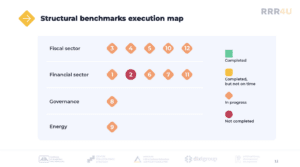
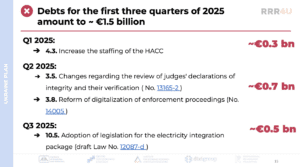
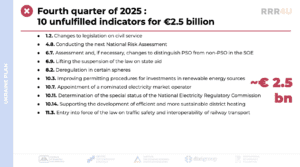
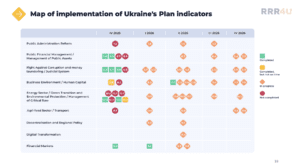
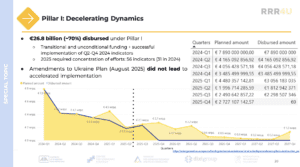
Unfulfilled indicators under Ukraine Plan continue to accumulate, leading to the loss of a significant amount of EU support and effectively putting key reforms at risk. As of the end of 2025, Ukraine failed to meet 14 indicators worth more than €3.9 billion. The majority of these commitments were not fulfilled in Q4 2025, with 10 missed indicators amounting to €2.5 billion.
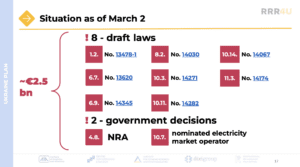
Progress on most of these steps requires the adoption of legislation, highlighting the need to restore the full functioning of Parliament and better synchronise its work with the Cabinet of Ministers to regain the lost reform momentum. By the end of Q1 2026, Ukraine must fulfil 8 indicators, of which 5 are currently at risk of non-fulfilment, potentially further deepening the negative trend by March.
Laws for receiving assistance from the World Bank
IMF
New IMF program – risks right from the start
The IMF Executive Board has decided on a new 4-year program for Ukraine in the amount of USD 8.1 bn
IMPORTANT: The program is an anchor for assistance from other partners (including the World Bank and the EU) – part of a USD 136.5 bn aid package.
USD 1.5 bn immediately after program approval due to implementation of prior actions (albeit revised):
- Adoption of the State Budget for 2026 , which meets the parameters of the Program
- Resolution of the Cabinet of Ministers that the evaluation of proposals in public procurement is carried out without taking into account VAT
- A draft Labor Code with an updated definition of hired labor has been submitted to parliament
12 structural benchmarks have been identified (partially inherited), but a number of obligations are spelled out in the text of the Memorandum ( ! ), and quantitative indicators have also been defined.
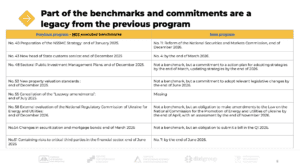
The Memorandum also sets out other important commitments (1)
In particular :
- Regular coordination of the parameters of the Budget Declaration and the State Budget
- Limiting opportunities for the use of the simplified taxation system for abuse: a bill by the end of 2026 to limit the practice of artificially splitting companies to maintain the right to stay below the thresholds set for preferential regimes; limit the ability for businesses to return to the simplified system after switching to the general taxation system.
- Other tax changes (without a deadline) include: (i) a comprehensive package of measures for the post-war period on carbon tax reform; (ii) an analysis and assessment of the taxation of extractive industries; (iii) the definition of principles for the taxation of virtual assets, consistent with EU rules, in particular on information exchange and OECD Global Forum initiatives.
- Further implementation of the public investment management reform: draft law by the end of March 2026 to improve the integration of the PIM into medium-term budget planning and fiscal risk management, in particular regarding: (i) the use and accounting of multi-year budget commitments and contingent liabilities for public investment projects; (ii) the identification of contingent liabilities that may arise within public-private partnerships; (iii) the management and disclosure of fiscal risks associated with public investments; (iv) the budgeting of public investments at the local level.
The Memorandum also sets out other important commitments (2)
In particular :
- Carrying out pension reform, but no timelines have been set: should not widen the deficit.
- Adoption of the draft law on investment funds ( No. 13246 ) by the end of October 2026 as part of the implementation of the roadmap for the reform of the financial and capital markets infrastructure. The Memorandum also provides for other measures and deadlines for the implementation of the roadmap.
- A number of measures in the field of combating money laundering with implementation deadlines during 2026-2027.
- Important changes will occur in the area of corporate governance of state-owned enterprises: independent supervisory boards, charters, transparency, accountability, etc.
- By the end of June 2026, the CMU will adopt a roadmap for the gradual liberalization of the gas and electricity markets with an implementation plan after the lifting of martial law. It will identify the steps needed to reform the PSO to gradually liberalize market prices after the end of martial law, ensuring adequate protection of vulnerable consumers through a subsidy mechanism.
It is important that the memorandum provides:
- Maintaining the independence of the NBU.
- Further effective work of the BEB.
- Commitment to maintain the operational independence of the National Anti-Corruption Bureau of Ukraine (NABU), the Specialized Anti-Corruption Prosecutor’s Office (SAP), and the High Anti-Corruption Court (HACC).
EU
Ukraine Plan: main updates as of February 2026
- Ukraine is significantly lagging in implementing reform indicators. In total, 14 indicators worth over €3.9 billion were not met in 2025. Of these, 10 indicators for the fourth quarter worth €2.5 billion.
- According to the results of the Q1 2026, Ukraine may irretrievably lose almost €0.3 billion for the first time due to failure to fulfil the indicator of Ukraine’s Plan for increasing the staff of the High Anti-Corruption Court since last year.
- Of the 8 indicators that need to be completed by the end of the Q1 2026, so far only 1 has been completed on time, and there are risks for 5 of them.
SPECIAL TOPIC — «Two years of the Ukraine Facility: results and challenges»
Pillar III: Routine Operations
➤ Funding areas:
- technical assistance (Technical Cooperation Facility, TCF), including grants, direct procurement, and contractors (indirect management); beneficiaries – government entities, local authorities, CSOs, and media;
- EU contributions to the Extended Partial Agreement on the Register of Damage caused by the RF aggression against Ukraine;
- coverage of servicing costs, liquidity management, and administration of borrowings under Pillar I of the Ukraine Facility (borrowing costs subsidy);
- coverage legacy costs linked to the loans under the exceptional macro-financial assistance in 2022 and some costs under EIB guarantees (financial obligations under the External Lending Mandate 2014-2020);
- audit services for the entire Ukraine Facility
➤ 2024: €488 million, incl. €260.68 million TCF, €227.86 million borrowing costs
➤ 2025: €790 million, incl. €389 million TCF, €400 million borrowing costs
➤ 2026-2027: 2-year program for €2.288 billion approved in January, including €313.52 million TCF, €2.66 billion borrowing costs
You can view the previous monitors on the website RRR4U
The monitoring was prepared with the support of the International Renaissance Foundation.
RRR4U (Resilience, Reconstruction and Relief for Ukraine) is a consortium of four Ukrainian civil society organisations: Centre for Economic Strategy, Institute for Economic Research and Policy Consulting, Institute of Analytics and Advocacy and DiXi Group.