One of the areas of reform that is important in both numerous IMF programs and EU support programs is the introduction of effective corporate governance. Much has been done at the legislative level, but there is still a long way to go. Today, Ukraine is making another leap forward in appointing supervisory boards to increase the efficiency of state-owned enterprises.
That is why during the discussion “Corporate Governance Reform: How to Achieve Success?”, which took place on January 30, 2026, during the presentation of the 23rd monitoring of the implementation of the IMF program and the Ukraine Facility plan, leading experts and government representatives analyzed the state of corporate governance implementation in Ukrainian state-owned companies.
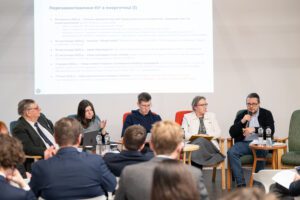
Leading IER expert Oleksandra Betliy noted that state-owned enterprises remain a source of significant fiscal risks. “The issue of corporate governance has always raised many questions, not only in the context of possible corruption, but also in the context of possible fiscal risks, i.e., higher government expenditures to cover companies’ losses, repay their debts if state-owned companies face financial difficulties, etc.,” she said.
The IMF and the EU pay a lot of attention to corporate governance issues in their support programs, which is reflected in numerous structural benchmarks and indicators. Ukraine has fulfilled most of its commitments at the regulatory and legislative level. However, the implementation of good corporate governance reforms remains problematic.
“Effective corporate governance means professionalizing the state as an owner, ensuring the efficiency, transparency, and integrity of state-owned enterprises. In essence, the main goal of the reform is to ensure the economic efficiency of state-owned companies, promote their sustainable development and accountability. And, of course, to get started, the state must clearly understand why it owns a particular enterprise and what results it should achieve,” emphasized Oleksandra Betliy.
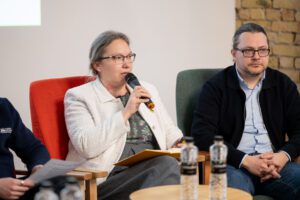
The OECD guidelines are the basis for the introduction of effective corporate governance in Ukraine. OECD policy analyst Talisia zur Hausen noted that even high-quality legislation needs protection from external pressure. She pointed out that Ukraine has indeed taken a significant step forward with the adoption of the relevant law (No. 3587), but supervisory boards still face political influence from manual intervention by the owner, i.e., the state.
“The 2021 OECD Corporate Governance Review for Ukraine identified the following risks: fragmented majority state ownership in state-owned enterprises, political interference in their operations, limited transparency at the level of state ownership portfolios, etc.,” Ms. zur Hausen noted.
The expert recommended that Ukraine move from “reform design” to “implementation discipline” and announced the publication of a new report in April 2026.
The experts paid particular attention to strategic sectors where management independence is a matter of national security.
Roman Nitsovych, research director at DiXi Group, confirmed that political interference in the operations of state-owned energy companies has a negative impact on their investment programs.
In particular, this may affect the implementation of repairs and programs to protect critical infrastructure, which Ukraine desperately needs during the war. However, the Mindichgate corruption scandal became a catalyst for a major overhaul of corporate governance in the energy sector. The state has committed to eliminating gaps that undermine both the manageability of the relevant companies and the trust of donors and creditors. We are talking about dysfunctional supervisory boards and politically dependent executive bodies.

Roman Nitsovych believes that, in addition to changing the composition of supervisory boards, they must be truly independent, without artificial vetoes by state representatives and “qualified majorities” for appointing management. First of all, the statutes of Ukrenergo and the Ukrainian Gas Transmission System Operator, which underwent similar distortions last year, should be amended.
“We also call for state-owned companies to gradually bring themselves into line with the requirements of EU directives on ESG corporate reporting and due diligence. This will significantly increase the confidence of creditors, as institutions such as the EBRD and the EIB do not grant loans to companies that have problems with corporate governance,” Roman Nitsovych concluded.
In the context of the practical challenges of wartime, Deputy Minister of Community and Territorial Development Yevhen Dubogryz emphasized the need for real, rather than formal, involvement of supervisory boards in the work of state-owned companies:
“The supervisory board should not be a ‘sweet deal’ with a market salary and little work. A market salary should entail fairly intensive work and high-quality communication between the owner and management.”
He also noted that the introduction of effective corporate governance is not an end in itself for the state, and it must begin with the question “why?” “The answer is different for each company, and it is this answer that determines the management architecture, the set of competencies, and the speed of decision-making,” said Yevhen Dubogryz.

This thesis was supported by People’s Deputy Oleksiy Movchan, who added that the success of the reform is being hampered by the lack of a common vision among the various branches of government.
“We need to unify the policy of selecting people in order to avoid appointments based on political criteria, which then become an obstacle to the development of entire industries,” he said.
Artem Shevalov, deputy chairman of the supervisory board of PrivatBank, expressed an important caveat regarding the financial independence of board members:
“Sometimes the supervisory board may have to become the ‘last bastion’ that can protect assets from unhealthy initiatives at the highest level. Because sometimes political expediency can override economic common sense… In this situation, the supervisory board is the ‘last bastion’ that must protect the asset in the interests of a wider range of stakeholders.”
Olga Kosharna, co-founder of the NGO “Anti-Crisis Expert Nuclear Center of Ukraine,” critically assessed the practice of appointing current officials to supervisory boards (using Energoatom as an example) and pointed out the possible lack of time for such specialists to perform their duties professionally.
“What official, with a full-time job, will be able to devote sufficient time to the strategy of a large state-owned enterprise? This is a direct violation of procedures and a conflict of interest that we must eliminate,” said the expert. She called for strict adherence to the procedures for dismissing and appointing board members in accordance with the law.
The process of building a new culture is complex, and, as noted by Iryna Kravchenko, Deputy Head of the EBRD in Ukraine:
“The path to reform is not perfect, but progress is evident. It is not only about passing laws, but about creating institutions that will stand the test of time and become a professional filter against interference.”
The monitoring was prepared with the support of the International Renaissance Foundation.
RRR4U (Resilience, Reconstruction and Relief for Ukraine) is a consortium of four Ukrainian civil society organisations: Centre for Economic Strategy, Institute for Economic Research and Policy Consulting, Institute of Analytics and Advocacy and DiXi Group.