This analytical document (WINTER OUTLOOK 2025. Electricity) examines the state of Ukraine’s energy system ahead of the 2025-2026 winter period, assesses key risks, and outlines potential scenarios for ensuring energy security in wartime conditions. The analysis is based on an attempt to apply the methodology of the European Network of Transmission System Operators for Electricity (ENTSO-E), which incorporates principles of short-term and seasonal adequacy of power systems.
Availability forecast for AWP 2025/2026
Planning the operation of the power system in wartime conditions involves a significant degree of uncertainty, as the scale and number of new Russian attacks cannot be predicted. Additionally, extreme frosts down to -20-25°C could significantly affect the power system’s ability to operate stably due to risks of power line breaks from wet snow or ice, the need to shut down damaged TPPs during frost, and the overall critical state of the grids.
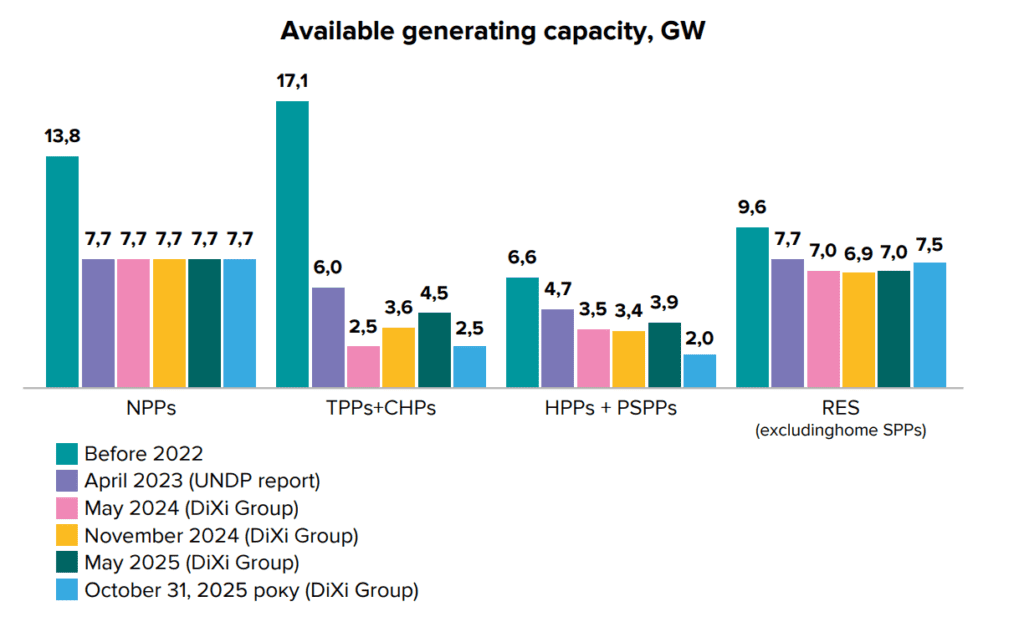
According to DiXi Group’s estimates, on the eve of the previous heating season Ukraine had more than 15 GW of available capacity, which made it possible to avoid the widespread and regular use of hourly power outage schedules.
In October 2025, Ukraine imported 353.9 thousand MWh of electricity, which is 2.5 times more than in September 2025. In November, imports reached 414.7 thousand MWh, the highest level since the beginning of the year. The increase in imports was driven by the deterioration of the power system due to massive attacks on energy infrastructure; therefore, this trend is expected to continue throughout the 2025–2026 heating season.
The document examines three main scenarios for the winter period:
The optimistic scenario (probability 25-30%)
ASSUMES NO NEW ATTACKS ON THE POWER SYSTEM AND MODERATE TEMPERATURE CONDITIONS
Under this scenario, all nine nuclear power units operate at their nominal capacity of 7.7 GW, providing the base load of the power system. Thermal generation restored after the attacks, together with new distributed gas generation commissioned in 2024–2025 (1.5 GW), provides 3.8 GW of capacity. Hydropower generation is constrained by low water levels in the Dnipro cascade and can supply up to 1.0 GW for peak balancing. Renewable generation during evening peak hours is expected to reach around 0.5 GW, primarily from wind power. Commercial imports and emergency assistance from EU countries, in the absence of transmission constraints, can supply up to 2.0 GW out of the available 2.3 GW of cross-border transmission capacity.
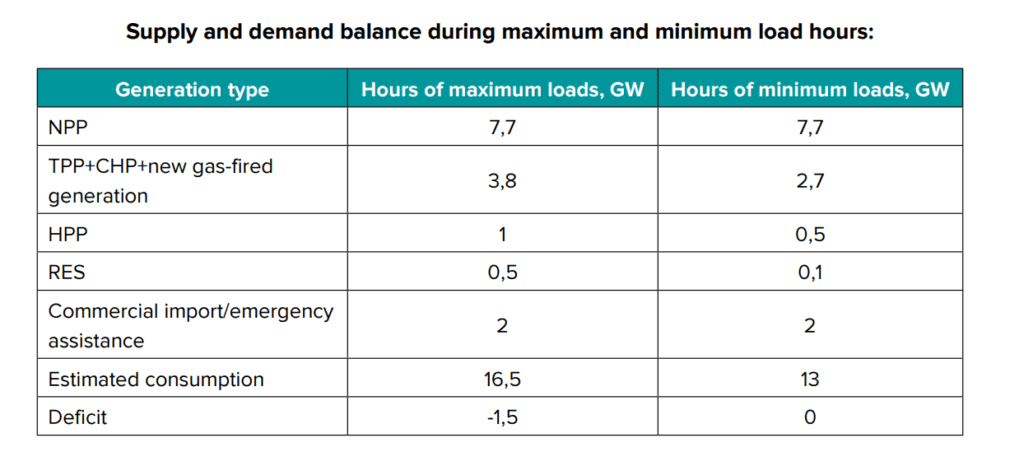
The total available capacity will amount to 15 GW against demand of 16.5 GW, resulting in a 1.5 GW deficit during peak hours. This implies regular outages affecting 1–2 load groups, primarily in the evening, with 3–4 groups applied on an episodic basis. The Loss of Load Probability (LOLP) will stand at 20.5%.
Regional differentiation will be significant: western regions will have an LOLP of 12–15%, central regions 20–23%, eastern and southern regions 25–28%, and frontline areas 35–45%.
The baseline scenario (probability 50-60%)
ASSUMES FURTHER DESTRUCTION OF FLEXIBLE GENERATION AND GRID INFRASTRUCTURE UNDER MODERATE TEMPERATURE CONDITIONS
The projected consequences of the attacks include the additional outage of 0.8–1.0 GW of thermal generation due to damage to restored thermal power plant units. Constraints on nuclear power output may reach 1.5–2.0 GW as a result of damage to 750 kV substations at the Rivne, Khmelnytskyi, and South Ukraine nuclear power plants and the destruction of transformer equipment. Hydropower generation may lose 0.3–0.5 GW. Grid constraints could potentially prevent the transmission of 0.5–1.0 GW between regions due to damage to backbone transmission lines and the isolation of certain regions.
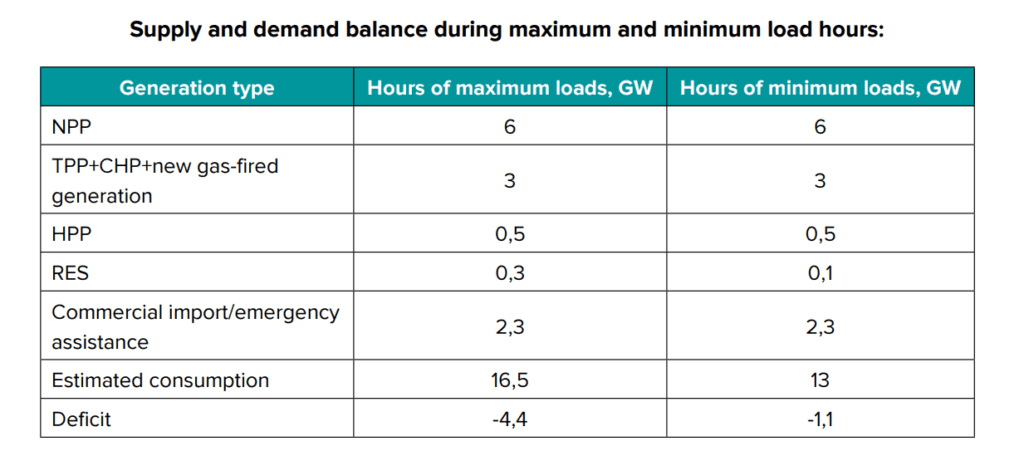
Available capacity would decrease to 12.1 GW, with the peak-hour deficit reaching 4.4 GW. The system would operate in a state of permanent deficit virtually around the clock, with a Loss of Load Probability (LOLP) of 100%. The expected volume of unserved energy would amount to approximately 21–22% of demand.
The worst-case scenario (probability 15-20%)
ASSUMES FURTHER DESTRUCTION OF FLEXIBLE GENERATION AND GRID INFRASTRUCTURE, ALONG WITH A SIGNIFICANT INCREASE IN DEMAND DUE TO A DROP IN AVERAGE DAILY TEMPERATURES
Historically cold winters in Ukraine occurred in 2005–2006, 2009–2010, and 2011–2012, when temperatures briefly fell to –20…–25°C and remained at –10…–15°C for several weeks. This scenario assumes 2–3 weeks with average daily temperatures below –10°C, with individual days dropping to –20°C, leading to a sharp increase in electricity demand due to expanded use of electric heating, higher internal consumption by combined heat and power plants (CHPs) and boiler houses, and increased demand from the commercial sector.
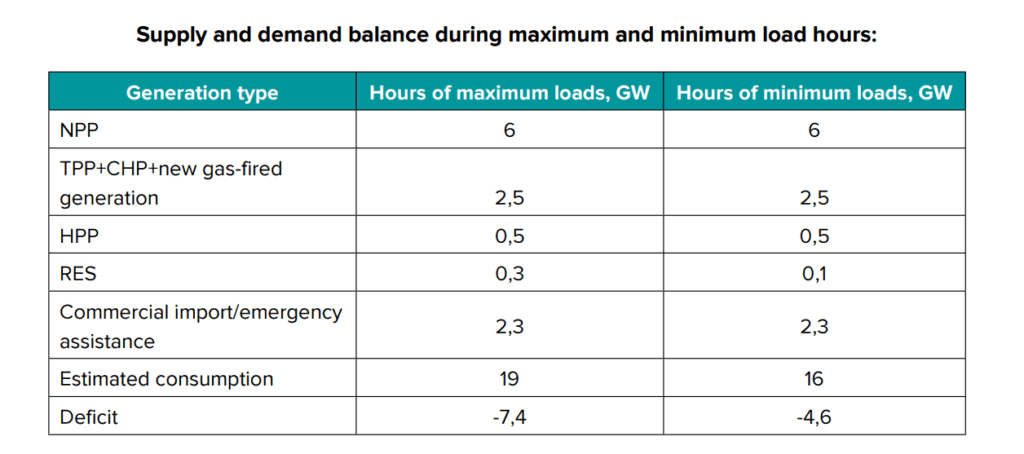
Electricity demand would rise to 18.5–19 GW, with the peak-hour deficit reaching 7.4 GW. Frontline regions (Chernihiv, Sumy, Kharkiv, Zaporizhzhia, and Kherson) would face a critical situation with a Loss of Load Probability (LOLP) of 70–85%, meaning electricity supply would be available for only 4–8 hours per day. The risk of cascading failures and loss of power system integrity would be high
This material was prepared by DiXi Group with the support of the International Renaissance Foundation within the project “Improving Tomorrow’s Energy Security.” The content reflects the views of the authors and does not necessarily represent the position of the International Renaissance Foundation.