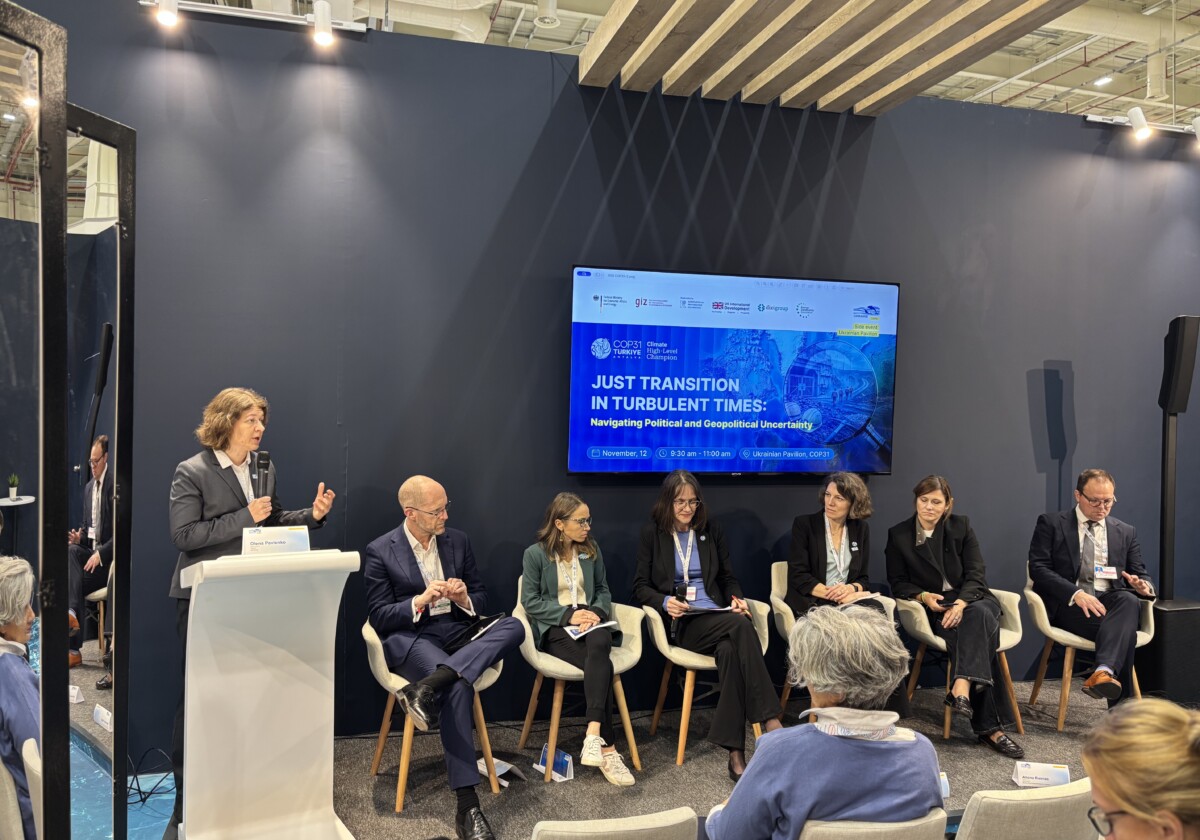
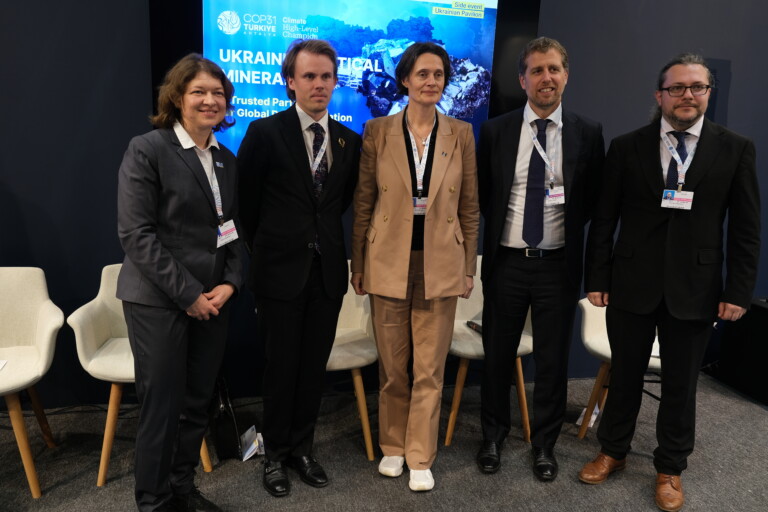
How to transform the Strategy for the Development of Industries Based on Mineral Resources and Components of Strategic and Critical Importance, adopted in June 2026, into projects attractive to investors this was the topic of discussion at the Ukrainian Pavilion during the 31st Conference of the Parties to the United Nations Framework Convention on Climate Change (COP31).
Representatives of the Ukrainian government, the mining industry, international organizations, and the expert community participated in the discussion titled “Ukraine’s Critical Minerals: A Reliable Partnership for Global Decarbonization”.
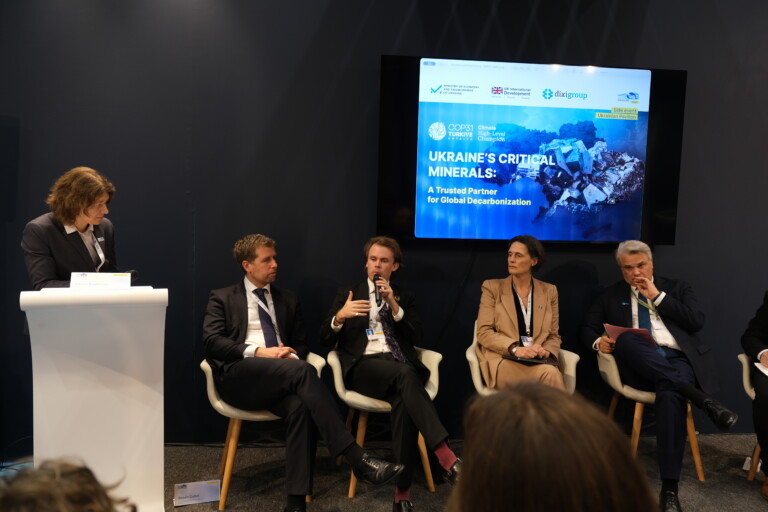
Olena Pavlenko, President of DiXi Group, emphasized while moderating the event that Ukraine could, in the foreseeable future, compete with countries that currently hold a monopoly on the market for critical raw materials and contribute to the global transition to clean energy.
“The sector’s development in line with the adopted Strategy will help strengthen energy security and national security as a whole not only for Ukraine but also for countries aiming to focus on decarbonization, electrification, and the broader use of RES in the future”, – DiXi Group President assured.
The Strategy was presented by Yuliia Radchenko, Head of the Subsoil Use Department at the Ministry of Economy and Environment of Ukraine. Ukraine aims to become a leading manufacturing hub in Europe, and the export of products manufactured from these mineral resources is expected to become one of the top five sources of currency earnings.
“The objective is to create high value-added industries and meet the needs of both the domestic and global markets. We have 4 strategic goals: to accelerate the implementation of investment projects, integrate into global supply chains, strengthen competitiveness, and build a circular economy”, – the government official explained.
Ksenia Orynchak, Executive Director of the National Association of the Extractive Industry of Ukraine, also highlighted the sector’s potential. Ukraine possesses reserves of 26 out of 34 types of minerals and components that the EU classifies as critical. One of the graphite deposits has already been recognized as a strategic project in accordance with the EU Regulation on Critical Raw Materials.
“The Ukrainian mining industry currently faces three main challenges, each of which is caused by Russia’s armed aggression: power shortages, logistical problems that are driving up the cost of exports or halting them altogether, and, of course, the occupation, which has affected, for example, two of the four major lithium deposits. Despite all this, Ukrainian companies are not stopping their operations. They continue to pay taxes and salaries, and invest in their own power generation, energy storage, and security. This is what resilience looks like in practice”, – Orynchak is convinced.
Simon Cutler, Head of International Government Relations and Public Policy at Fortescue, noted that Ukraine has great potential in the minerals sector and a clearly defined strategy. In the long term, investors will focus on whether the regulatory framework and policies remain stable and whether investment conditions remain attractive. He added that one of the main concerns at the moment may be time, since it takes an average of 15–16 years from the discovery of a deposit to the start of production.
“Such timeframes are too long for Ukraine to achieve its ambitions in the global market for critical raw materials and energy transition technologies. Therefore, any joint efforts by the business community and the government aimed at optimizing these processes will be extremely important”, – Cutler noted. He emphasized that this does not mean bypassing procedures or stages, but rather streamlining and accelerating work processes.
At the same time, John Lindberg, Senior Manager for Policy and Government Relations at the International Council on Mining and Metals (ICMM), emphasized the need to implement the Strategy consistently and to recognize that fundamental changes may require trial and error.
Regarding sources of funding for project implementation, Anthony Agota, the EU Special Envoy for Climate and Environment at the European External Action Service, assured that investors are ready to act when the opportunity arises although Ukraine is not yet fully integrated into European supply chains, it is moving in that direction.
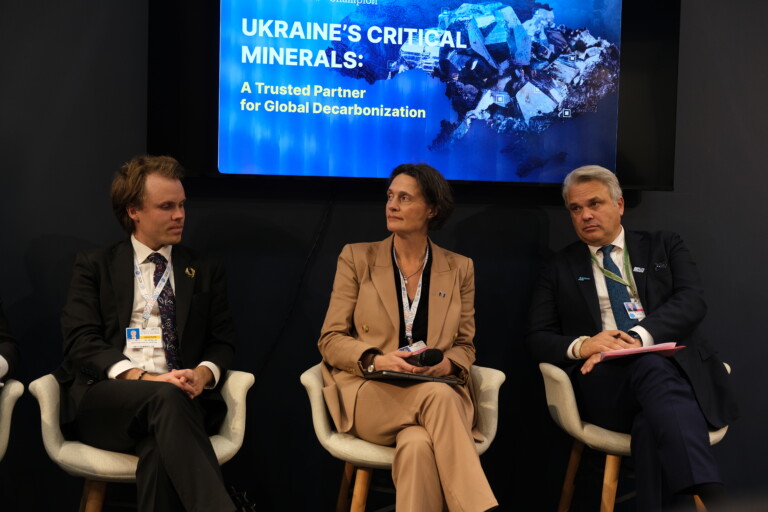
Amy Barnes, head of the global energy and electric power practice at Marsh, noted that, for now, war risks should be covered primarily through government or partner funding. In her view, the cost of such insurance from the private sector will remain high in the medium term.
“Ukraine should update its legislation in accordance with the current Extractive Industries Transparency Initiative (EITI) Standard and continue harmonizing with EU law to increase the trust of both investors and the public,” said Roman Nitsovych, Research Director at DiXi Group. – “Transparency is a fundamental value because it helps build that trust. It is also essential for ensuring the sustainability of projects and can help prevent potential conflicts, as any doubts or concerns can be exploited to the detriment of projects. To avoid this, we must apply best practices, one of which is the EITI.”
Participants in the discussion agreed that the green transition is impossible without critical minerals. The speakers shared their recommendations on practical steps Ukraine should take to turn political commitments into projects that are attractive to investors and into sustainable, diversified supply chains that support this transition.
For more details about the DiXi Group event at COP31, watch the livestream: https://www.youtube.com/live/JAxLhmNlvnM?si=rkf2SF8Vs5T0CMuo