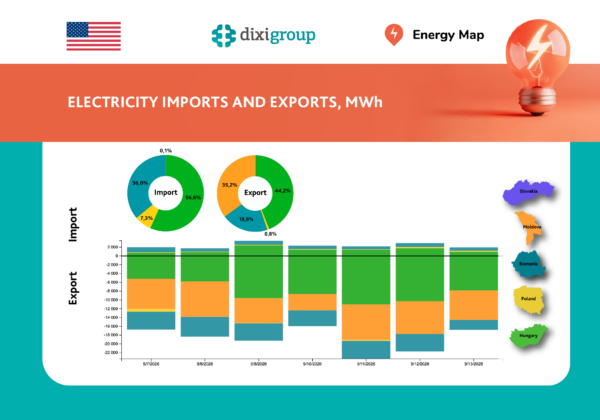
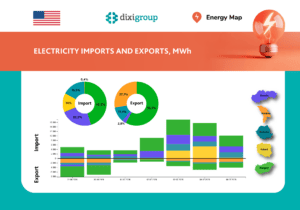
According to Energy Map data, electricity imports to Ukraine increased by 37% during the period from 29 June to 5 July compared to the previous week, reaching 64.6 GWh. At the same time, electricity exports declined by 38%, totaling 30.9 GWh.
The increase in electricity consumption during the week was primarily driven by hot weather, which led to widespread use of air conditioning systems. Toward the end of the week, cloudy conditions and rainfall in the western and central regions also reduced electricity generation from residential rooftop solar installations, placing additional pressure on the power system.
Meeting the increased demand was complicated by limited generation reserves due to the consequences of russian attacks, scheduled maintenance at generation facilities, and rising electricity prices in neighboring countries, which restricted commercial import options. To maintain the balance of the power system, hourly outage schedules for households and power limitation measures for businesses and industry were implemented on June 30 and July 1 between 17:00 and 22:00. In addition, emergency power outages were implemented in certain regions on June 29-30 and July 3.
Under these conditions, imports remained a key tool for balancing the energy system. Compared to the previous week, supply volumes increased across all directions.
Import structure by country:
- Hungary – 29.4 GWh (45.5%);
- Slovakia – 15.0 GWh (23.2%);
- Romania – 11.0 GWh (16.9%);
- Poland – 9.0 GWh (14.0%);
- Moldova – 0.2 GWh (0.4%).
Electricity exports were carried out during periods of surplus generation. At the same time, exports were minimal or non-existent during peak load hours in the morning and evening.
Export structure by country:
- Hungary – 17.9 GWh (58.1%);
- Moldova – 8.6 GWh (27.7%);
- Romania – 3.5 GWh (11.4%);
- Slovakia – 0.9 GWh (2.8%).
Overall, over the course of the week, electricity imports to Ukraine exceeded exports by a factor of 2.1.
The EST project supports key U.S. administration priorities by advancing its energy interests and expanding opportunities for American companies in Ukraine’s energy sector. By strengthening transparency and anti-corruption safeguards, the project helps foster a more predictable, rules-based environment that can support fair competition and encourage investment. Through support for market-oriented reforms and stronger data systems, EST contributes to U.S. economic interests while reinforcing U.S. leadership in the global energy sector.
This report is made possible by the generous support of the United States Government. The contents are the responsibility of DiXi Group and do not necessarily reflect the views of the United States Government.