Last year, total electricity consumption in Ukraine amounted to 80.2 billion kWh, which is 3.6% lower compared to 2024 and 36.2% lower compared to 2021, before the full-scale war. Of this volume, 51.1 billion kWh was consumed by non-household consumers, while 29.1 billion kWh was consumed by households. This is according to data from the Energy Regulator (NEURC), published on the Energy Map portal.
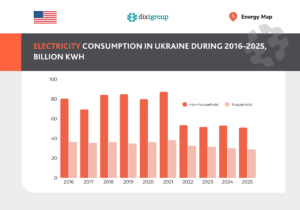
Since the beginning of the full-scale invasion, electricity consumption in Ukraine has declined significantly. In 2021, total consumption stood at 125.7 billion kWh, while in 2022 it dropped to 86.1 billion kWh, or by 31.5%. In subsequent years, the indicator remained relatively stable within the range of 80-83 billion kWh per year.
Overall, in 2025 electricity consumption was 45.5 billion kWh lower compared to the pre-war level of 2021. This trend indicates that electricity demand has not only failed to recover to pre-war levels, but has continued to gradually decline.
The largest reduction was observed among non-household consumers, primarily industry and businesses. In 2025, they used 51.1 billion kWh of electricity, which is 41.5% less than in 2021. For household consumers, the decline over the same period amounted to 24.1%, from 38.3 billion kWh to 29.1 billion kWh.
Before the full-scale invasion, non-household consumers accounted for 69.5% of total electricity demand, while in 2025 their share declined to 63.7%. At the same time, the share of household consumers increased from 30.5% to 36.3%.
The reduction in electricity consumption in 2022-2025 occurred amid the ongoing impact of the war on the energy sector and the broader economy.
“Factors that may have influenced electricity demand include the destruction of energy and industrial infrastructure, loss of control over parts of the territory, internal displacement and outflow of population abroad, reduced business activity, as well as stabilization electricity outages”, Oksana Zuieva, DiXi Group open data senior expert, noted.
At the same time, distributed generation has been actively developing in Ukraine in recent years, and this trend appears to be persistent. Households and businesses are increasingly investing in their own solar power plants and other backup generation sources, which partially cover their own electricity needs and reduce the volume of electricity drawn from the grid.
The EST project supports key U.S. administration priorities by advancing its energy interests and expanding opportunities for American companies in Ukraine’s energy sector. By strengthening transparency and anti-corruption safeguards, the project helps foster a more predictable, rules-based environment that can support fair competition and encourage investment. Through support for market-oriented reforms and stronger data systems, EST contributes to U.S. economic interests while reinforcing U.S. leadership in the global energy sector.
This report is made possible by the generous support of the United States Government. The contents are the responsibility of DiXi Group and do not necessarily reflect the views of the United States Government.