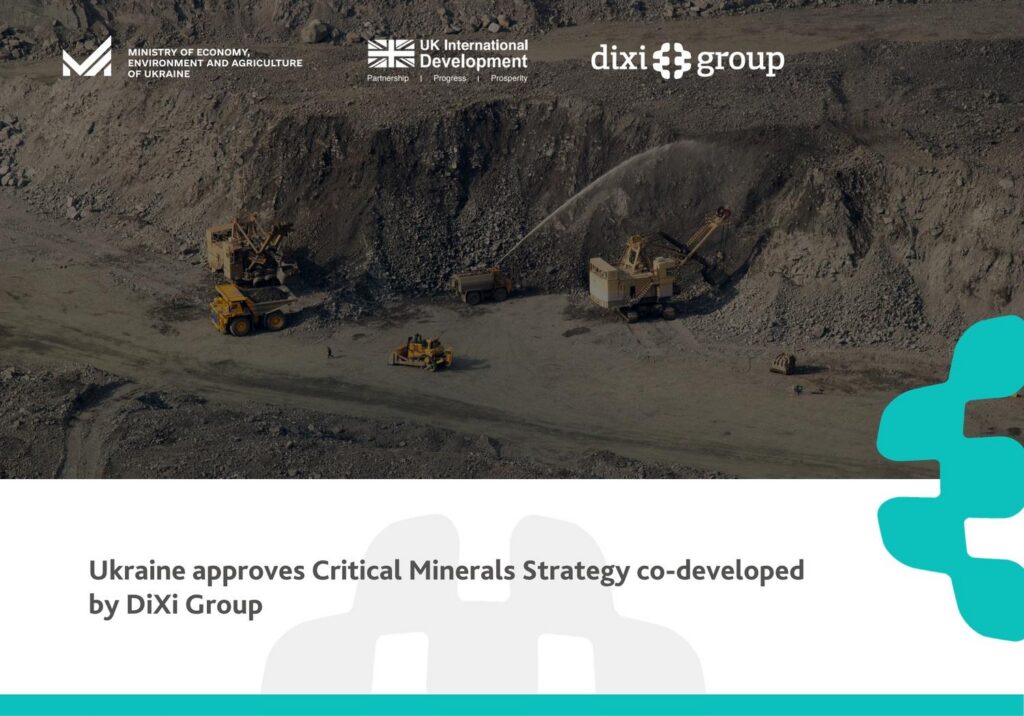
The Cabinet of Ministers of Ukraine has approved the Strategy for the Development of Industries Based on Strategic and Critical Raw Materials by 2056 (Critical Minerals Strategy), along with the 2026-2028 Action Plan for its implementation. The documents were developed by the DiXi Group team with support from the Ministry of Economy, Environment and Agriculture of Ukraine.
The Strategy is intended to facilitate Ukraine’s integration into global supply chains across the full value chain – from the extraction and processing of critical minerals and components through to the manufacture of intermediate and finished products. Supporting Ukraine’s high-value-added industries on the basis of its mineral resource potential is expected to help meet domestic economic needs and increase foreign currency revenues through exports.
“The Strategy to 2056 sets a clear development trajectory for the sector. It is a comprehensive vision that helps focus our initiatives and actions. For us, this document is above all an opportunity to better prioritise key areas of sector development that require capital, technology and long-term offtake contracts. We are working to ensure that Ukraine develops not only extraction, but also processing, infrastructure, human capital and high-value-added production,” said Deputy Minister of Economy, Environment and Agriculture Yegor Perelygin.
The Strategy focuses primarily on removing the regulatory barriers that constrain sector development and on improving its investment attractiveness.
“The document will help reform governance and regulation in the critical raw materials space – investors need predictability, transparency and stronger state capacity to support projects. Improving the quality of geological data, streamlining the permitting system, developing mechanisms to support projects and reduce investment risk, and transitioning to leading international standards and practices – these are the central priorities of the Strategy,” said DiXi Group President Olena Pavlenko.
Key strategic directions include:
- Accelerating the implementation of priority investment projects aimed at scaling up the extraction and processing of strategic and critical raw materiala;
- Integrating Ukraine into global supply chains through investment attraction and international cooperation;
- Enhancing competitiveness through optimisation of production costs, infrastructure development, human capital, research and innovation;
- Developing a circular economy by recovering and recycling critical raw materials from waste.
Depending on the readiness of the resource base and industrial potential, the Strategy identifies three groups of priority production chains. First-order priorities – for which specific targets for developing full production chains have been set – are titanium, graphite, manganese, uranium, zirconium and hafnium. Second-order priorities, where the Strategy aims to lay the groundwork for future development, include beryllium, germanium, lithium, tantalum and rare earth elements. A further category of strategic interest – aluminium, gallium and potassium salts – covers areas where industrial production could be restored under the right conditions.
The Strategy was developed taking into account input from representatives of the Governments of the United Kingdom and France, experts from the Organisation for Economic Co-operation and Development (OECD) and the International Energy Agency (IEA), as well as working consultations with business representatives and Ukrainian experts, and materials from international consulting firms.
The preparation of the Strategy involved consultations with a wide range of stakeholders, including companies from various sectors, research and academic institutions, territorial communities hosting deposits and related industrial facilities, and international financial institutions and development banks. Dedicated discussions were also held with key companies in the extractive sector. The draft underwent a strategic environmental assessment and all stages of public consultation as required by Ukrainian law.
The full text of the Strategy is available in Ukrainian.
The development of the document was made possible with the financial support of the UK Agency for International Development under the project “Implementation of the National Energy and Climate Ukraine Plan and establishment of the Green Economic Transition Office” implemented by DIXI GROUP NGO.