Four years have passed since russia turned Europe’s largest nuclear power plant into a military facility. The occupation of the Zaporizhzhia Nuclear Power Plant became part of the Kremlin’s strategy to use nuclear energy as an instrument of war and geopolitical pressure.
This was made possible by the state nuclear corporation Rosatom, operating at the intersection of energy, defense industry, digital infrastructure, and international expansion.
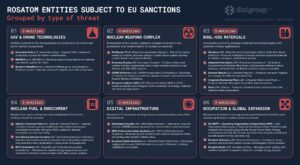
Based on its analytical research, DiXi Group identified 21 Rosatom entities embedded in russia’s military-industrial complex, structured across six interconnected areas:
- UAV & DRONE TECHNOLOGIES – 3 entities
- NUCLEAR WEAPONS COMPLEX – 4 entities
- DUAL-USE MATERIALS – 5 entities
- NUCLEAR FUEL & ENRICHMENT – 3 entities
- DIGITAL INFRASTRUCTURE – 3 entities
- OCCUPATION & GLOBAL EXPANSION – 3 entities
This is an ecosystem in which each element reinforces the others. Sanctions targeting individual components or companies preserve the functionality of the entire structure. It is precisely this structure that ensures the technological resilience of the sector, financial flows, and the international presence of russia’s nuclear industry.
The EU must move from selective measures to a systemic approach. Sanctions should simultaneously target the entire Rosatom ecosystem across all six areas – synchronized with partners and accompanied by clear deadlines for phasing out cooperation.
The full list of entities and detailed sanctions recommendations is available on the DiXi Group website: https://bit.ly/4rLHvQq
The material was prepared by the NGO DiXi Group with the support of the International Renaissance Foundation within the project “Strengthening Ukraine’s Resilience in Energy (SURE)”. The content reflects the views of the authors and does not necessarily reflect the position of the International Renaissance Foundation.”