According to Energy Map, as of January 1, 2026, household debt for heating and hot water amounted to about UAH 35.8 billion. Over the past year, the total debt has remained almost unchanged – it is only UAH 16.8 million lower (<1%) than at the beginning of 2025.
The largest debtors are consumers in the Kharkiv region, the city of Kyiv, and the Dnipropetrovsk region. However, among these three, an increase in debt over the year was recorded only in the Kharkiv region – by 5.5% (from UAH 8.5 to 9.0 billion). In Kyiv city, the debt decreased by 1.5% (from UAH 7.8 to 7.7 billion), while in the Dnipropetrovsk region it declined by 4.8% (from UAH 4.8 to 4.6 billion).
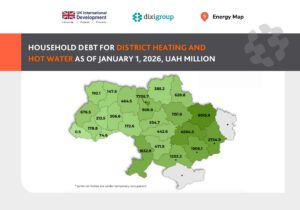
Overall, as of January 1, 2026, compared with the beginning of 2025, debt increased in six regions. In addition to Kharkiv region, growth was recorded in:
- Donetsk region – from UAH 2,386.4 million to UAH 2,734.9 million;
- Zaporizhzhia region – from UAH 1,820.6 million to UAH 1,906.1 million;
- Poltava region – from UAH 1,143.0 million to UAH 1,151.6 million;
- Ternopil region – from UAH 210.7 million to UAH 213.5 million;
- Vinnytsia region – from UAH 171.3 million to UAH 172.6 million.
In other regions, debt decreased over the year. The largest reduction was recorded in Zakarpattia region, where debt fell by 70.6% (from UAH 1.7 million to UAH 0.5 million). Significant declines were also observed in Ivano-Frankivsk region – by 24.7% (from UAH 237.4 million to UAH 178.8 million), Rivne region – by 18.6% (from UAH 181.4 million to UAH 147.6 million), Chernivtsi region – by 17.4% (from UAH 90.3 million to UAH 74.6 million), and Khmelnytskyi region – by 12.6% (from UAH 351.1 million to UAH 306.8 million). In the remaining regions, debt declined by 1.5-10.3%.
59.6% of all household debt for heating and hot water is concentrated in just three administrative units: the city of Kyiv, Kharkiv, and Dnipropetrovsk regions. Another five regions have debts exceeding UAH 1 billion:
- Donetsk – UAH 2.7 billion;
- Zaporizhzhia – UAH 1.9 billion;
- Odesa – UAH 1.6 billion;
- Kherson – UAH 1.2 billion;
- Poltava – UAH 1.2 billion.
Meanwhile, 16 other regions together account for only UAH 5.8 billion of debt, which represents 16.3% of the total.
The smallest debt is recorded in Zakarpattia region – only UAH 0.5 million. This is explained by the near absence of centralized heating and hot water supply in the region.
In December 2025, the highest payment rates for heating and hot water services were recorded in Zakarpattia (137.8%) and Ivano-Frankivsk (120.6%) regions. The lowest payment levels were observed in the frontline regions of Kherson (56.7%) and Donetsk (56.2%). In the other 20 regions, payment levels ranged from 91% to 108%.
Debt dynamics
As of January 1, 2024, household debt for heating and hot water amounted to UAH 33.1 billion. Over two years, it increased by 8%, reaching UAH 35.8 billion by early 2026.
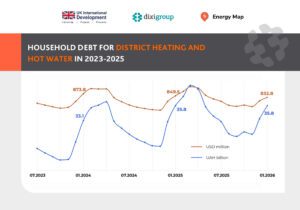
At the same time, in US dollar terms, the debt decreased by 4.7%, from USD 873.8 million to USD 832.8 million, which is explained by the depreciation of the Ukrainian hryvnia against the US dollar.
Debt peaks occur during the winter months, when the heating season is ongoing.
An important factor behind debt accumulation remains the moratorium on the suspension of utility services for non-payment. It was introduced by a resolution of the Cabinet of Ministers of Ukraine on March 5, 2022 across the entire country, and since April 27, 2023 has applied only in territories where hostilities are ongoing or that are temporarily occupied. While this mechanism protects household consumers, it simultaneously exacerbates the financial challenges faced by municipal utility companies.
Debt for other utility services
According to the Ministry for Development of Communities and Territories of Ukraine, as of 1 January 2026, household debt also amounted to:
- UAH 9.4 billion for centralized water supply and drainage services;
- UAH 2.6 billion for household waste removal.
At the same time, information on debts for the supply and distribution of natural gas and electricity is not published by the data administrator.
The publication was prepared with the financial support of the UK Agency for International Development under the project “Mainstreaming National Energy and Climate Plan for Ukraine’s Green Recovery and Strengthening the Green Transition Office” implemented by DIXI GROUP NGO. The contents of the publication are the sole responsibility of DIXI GROUP NGO and under no circumstances can be considered to reflect the position of the UK Agency for International Development.