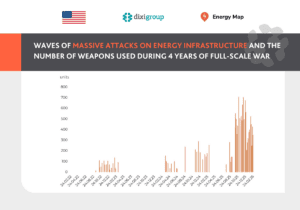
According to analysts at DiXi Group, since the beginning of the full-scale invasion, russia has carried out at least 64 massive attacks* on Ukraine’s energy infrastructure. During these attacks, approximately 12,700 attack UAVs and 2,900 missiles of various types were used – from cruise missiles, which are deployed most frequently, to ballistic missiles, which are the most difficult for air defense systems to intercept.
The assessment is based on a unique dataset compiled within the Energy Map portal. The data includes attacks that are designated as “massive” in reports by the Ministry of Energy of Ukraine or Ukrenergo. The data are further supplemented with information from the Ukrainian Air Force regarding the number and types of weapons used.
Since the beginning of the full-scale invasion, Ukraine’s energy infrastructure has been one of the key targets of russian attacks. The first months of the full-scale war were characterized by strikes on the fuel sector, particularly oil refineries and oil depots. This marked the initial phase of pressure on the energy sector.
However, from autumn 2022 onward, russia shifted to systematic massive missile and drone attacks on the energy system. This represents a deliberate strategy aimed, at a minimum, at undermining its stability and integrity, and at most at triggering a complete blackout. These were not isolated strikes, but rather a synchronized series of attacks involving the simultaneous use of dozens to several hundred weapons. The attacks occurred in waves and primarily coincided with autumn and winter periods, when system load is at its highest. Over four years of full-scale war, russia has conducted at least four such campaigns.
Since 2025, the scale and intensity of massive attacks have increased significantly. In 2022-2024, russia used approximately 2,800 missiles and drones in such strikes. In 2025-early 2026, this number rose to around 12,800.
The first large-scale campaign
Began on September 11, 2022, with strikes on Kharkiv CHP-5, Zmiivska TPP, and high-voltage transmission facilities in the Kharkiv region. The attacks subsequently spread to energy infrastructure nationwide.
A massive strike on November 15, 2022, left around 10 million consumers in Kyiv and 17 regions without electricity supply, and on November 23, it led to a systemic failure (blackout) of Ukraine’s power system, leaving the vast majority of consumers across the country without electricity.
The attacks continued until March 2023. The primary weapons used were missiles, mainly cruise missiles, and to a lesser extent, modified anti-aircraft and guided aircraft missiles. The focus was on the electricity sector: thermal and hydropower generation facilities, substations, and other elements of the high-voltage transmission grid.
The second large-scale campaign
A year later, in March 2024, russia resumed large-scale combined strikes on the energy sector. The second campaign lasted until August 2024. During this period, the scale of attacks increased, particularly due to more active use of strike drones. In March-June, up to 150 weapons were used in a single strike, and in August, more than 230.
In addition to attacks on electricity infrastructure, systematic strikes began against gas infrastructure – primarily ground equipment of underground gas storage facilities in western Ukraine. These attacks aimed to prevent European traders and other non-resident customers from using storage facilities, thereby indirectly undermining energy security.
The third missile and drone campaign
Three months later, with the onset of colder weather, russia launched a third missile and drone campaign, lasting from November 2024 to March 2025. During this period, the first massive strikes on gas production facilities in the Poltava and Kharkiv regions were recorded. The objective was to halt domestic gas production needed to meet household demand and centralized heating needs. The gas sector is also a key source of energy-related tax revenues for the state budget, so these strikes may have been intended to undermine the country’s financial stability.
The fourth campaign, which is ongoing
Began in July 2025. During this period, attack drones became the main component of massive strikes on critical infrastructure. In the second half of the year, the number of UAVs used in a single attack rose to several hundred. In October and December, strikes were recorded involving more than 600 drones in a single day.
At the beginning of this campaign (July – early November 2025), russia concentrated its strikes on gas infrastructure – production, processing, and storage facilities. The attacks continue to this day, but since late October 2025, the focus has shifted primarily to electricity and district heating infrastructure: generation facilities, high-voltage substations, other elements of transmission and distribution networks, combined heat and power plants, and even individual boiler houses.
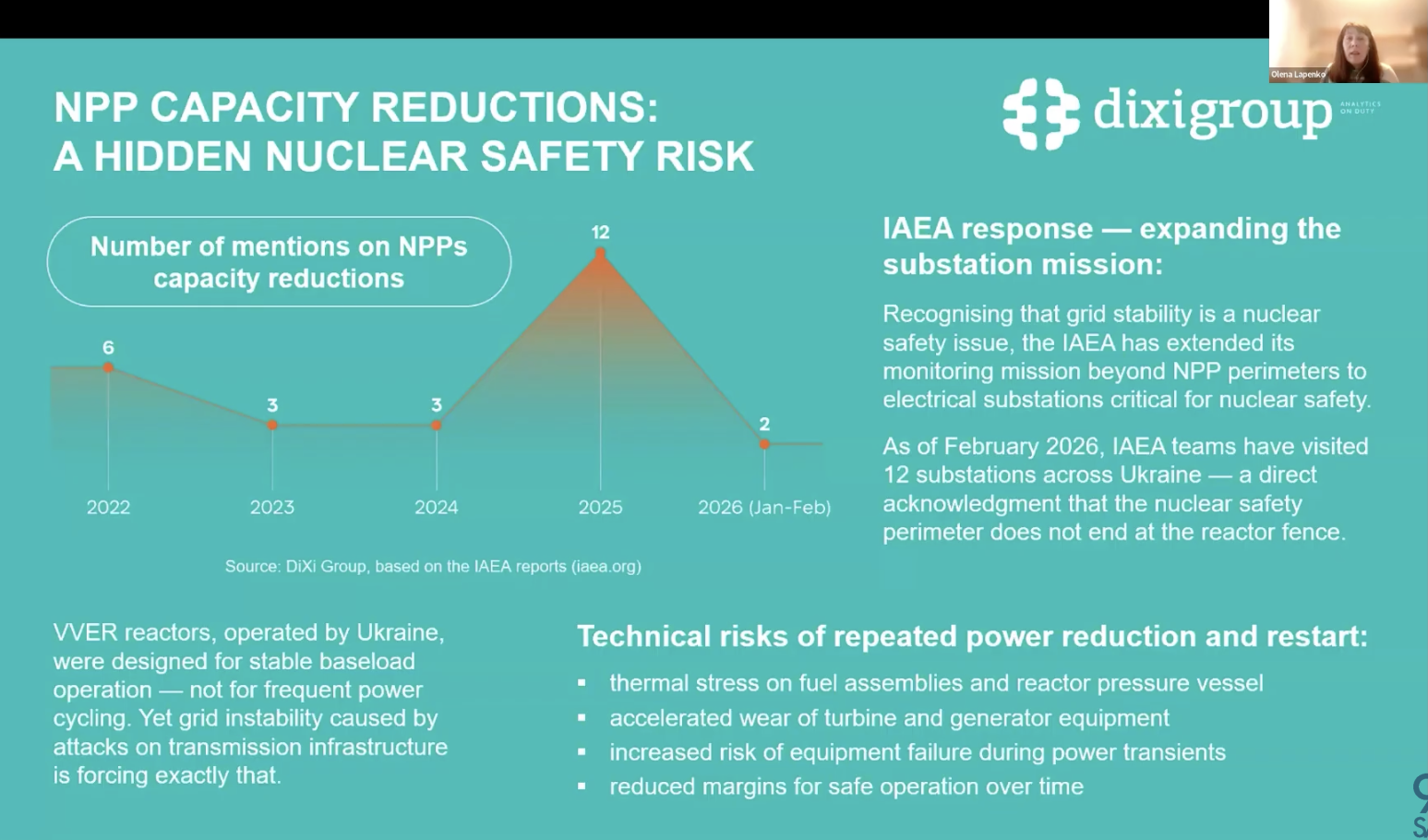
Some strikes were directed at substations that supply power from nuclear power plants to the grid. Formally, the nuclear power plant sites themselves did not suffer direct damage, but during at least seven attacks, power units were forced to reduce their load or shut down due to the activation of emergency protection systems.
russian strikes on energy infrastructure in western regions of Ukraine were also aimed at damaging transmission networks, thereby limiting the ability to deliver imported electricity to consumers.
Pressure on the capital became a regular feature of this campaign. In January 2026 alone, russia carried out four massive attacks primarily targeting Kyiv and its agglomeration. The selected targets – several large combined heat and power plants and substations – indicate intentions to completely cut off electricity and heat supply, particularly during the coldest periods. This may also suggest an attempt at psychological pressure and destabilization by creating intolerable living conditions.
Due to the extremely severe consequences of these massive attacks, a state of emergency was introduced in the electricity sector on January 16. The Ukrainian energy system has effectively switched to a mode of extremely strict restrictions. Whereas in previous years, consumption limitations and outages were emergency balancing tools, they have now become the basic operational mode.
According to President of Ukraine Volodymyr Zelenskyy, as of January 15, with consumption at around 18 GW, the system could supply only about 11 GW of capacity. On February 12, according to Energy Minister Denys Shmyhal, the forecast peak consumption was 16.4 GW, while available generation and imports totaled 12.3 GW, creating a deficit of 4.3-4.5 GW (reaching 5-6 GW during peak frost days). Actual available capacity and deficit levels are close to the worst-case scenario modeled by DiXi Group experts in the Winter Outlook 2025.
The latest russian campaign has significant humanitarian consequences – hundreds of thousands of Ukrainians remain without a stable electricity and heat supply amid low winter temperatures. The attacks cause cascading effects: disruptions to water supply, public transport, and other critical services, significantly affecting daily life, economic activity, and macroeconomic indicators.
According to National Bank Governor Andriy Pyshnyi, due to intensified attacks on energy infrastructure, the expected electricity deficit in 2026 was revised to 6%, which, under the NBU’s baseline scenario, could slow GDP growth by 0.4%. The National Bank also worsened its inflation forecast to 7.5% in 2026 and 6% in 2027. Prime Minister Yuliia Svyrydenko reported a decline in business activity and energy supply disruptions amid massive russian attacks, resulting in approximately UAH 12 billion in lost tax revenues to the state budget in January 2026 alone.
Thus, over four years of the “big war,” Ukraine’s power system has suffered significant losses due to systematic russian attacks. Around two-thirds of pre-war generating capacity has been occupied, damaged, or destroyed. Strikes on substations and high-voltage lines have complicated interregional electricity flows and limited the ability to transmit imported volumes. Notably, these campaigns have been carried out during the most challenging periods for the energy system and consumers – primarily during the heating season.
*A massive attack on energy infrastructure is defined as a coordinated strike in which a large number (from tens to hundreds) of weapons (missiles and UAVs) are used within a short period of time against one or several targets, with the aim of disrupting the stable operation of the energy system.
For this analysis, only attacks officially designated as massive in reports by the Ministry of Energy of Ukraine or NPC Ukrenergo were considered. DiXi Group analysts monitor such reports and supplement the collected data with information from the Ukrainian Air Force regarding the number and types of weapons used. Structured data covering the entire period of the full-scale invasion is available on the Energy Map portal.
Local strikes on energy facilities, which occur almost daily, especially in frontline and border regions, are not included in this data.
Campaigns are defined as a series of repeated attacks with short intervals between them; extended periods without massive strikes separate one campaign from another.
The material is made possible by the support of the American people as part of the Energy Sector Transparency Project implemented by DIXI GROUP. The information contained in this material is the sole responsibility of DIXI GROUP and can under no circumstances be taken to reflect the position of the U.S. Government.