DiXi Group, in partnership with the South African Institute of International Affairs, the Ilko Kucheriv Democratic Initiatives Foundation, and the Ukrainian Association of South Africa, presented a joint analytical report Enhancing Nuclear Safety: Protecting Nuclear Power Plants Against Military Threats during the international webinar Nuclear Energy in Times of War: Militarisation and the Protection of Nuclear Power Plants.
The report analyzes the situation around the Zaporizhzhia Nuclear Power Plant and broader challenges to nuclear safety during wartime. The authors propose updates to international approaches — from strengthening regulation to expanding the role of the International Atomic Energy Agency (IAEA) and protecting the entire infrastructure that ensures the operation of nuclear power plants.
In particular, DiXi Group’s contribution focused on how the condition of the power system affects nuclear power plant safety.
Since the start of the full-scale war, nuclear generation has accounted for around two-thirds of electricity production in Ukraine. This means that the stability of the entire energy system is directly linked to the stable operation of nuclear power plants. At the same time, the operation of these plants depends on the grid, which absorbs this electricity and ensures system balance.
Experts emphasized that the stable functioning of the power system is a fundamental prerequisite for the safe operation of nuclear power plants. Ukraine’s experience shows that even without direct attacks on reactors, damage to substations and grid infrastructure can immediately affect plant operating modes and create additional technical risks.
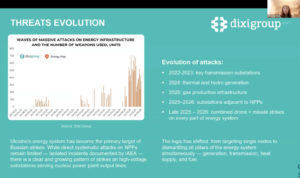
Russian attacks on energy infrastructure have evolved over the course of the war — from strikes on substations to complex, system-wide attacks, including facilities linked to the operation of nuclear power plants. In such conditions, risks to plants arise from grid instability.
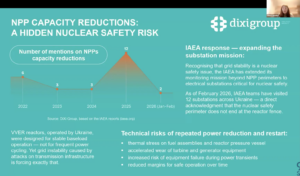
Due to damage to the energy system, operators are forced to work in a mode of frequent power fluctuations, although VVER-type reactors are designed for stable generation without significant load variations. This leads to equipment wear, increases technical risks, and reduces safety margins.
Particular attention should be paid to the cumulative nature of these risks: this is about continuous pressure on the system that gradually undermines its reliability and safety.
Experts concluded that nuclear safety is not limited to nuclear power plants but encompasses all critical infrastructure — from substations to electricity transmission systems. As a result, facilities that remain outside international legal protection become targets in modern warfare.
Link to research:
Participation in the study was made possible with the support of the International Renaissance Foundation as part of the project “Strengthening the Resilience of Ukraine’s Energy Sector.”