On 27 February, DiXi Group and the Green Transition Office held a public event supported by the International Renaissance Foundation. The panel discussions brought together government representatives, international financial institutions, the banking sector, and the business community around one question: how to turn available green finance into real transactions.
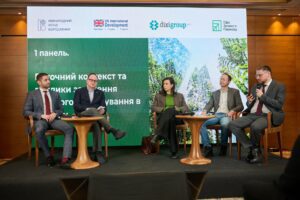
Participants in the first panel put their finger on a paradox at the heart of Ukraine’s green investment landscape — international partners are ready to invest, but cannot, because too few projects meet the required quality standards.
According to Anastasia Vereshchenska, Executive Director of the European-Ukrainian Analytical Agency, businesses complain about a lack of financing, but the problem runs deeper. The gap is not about instruments — it is about regulatory readiness and transparency. Without clear targets and openness to investors, capital simply cannot find its way to projects. In the renewable energy sector, the barrier takes a different form: there is no shortage of shovel-ready projects, but private investors still lack tools to hedge against war and market risks at the same time. Several international financial institutions are currently working on a mechanism to address this.
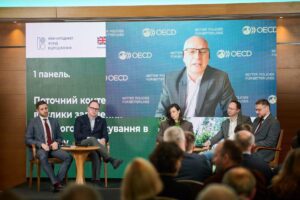
Andriy Kitura, Head of the Green Transition Office, put it plainly: “What is missing is collaboration between the participants in this process. We need a bridge — one that shows those willing to take on risk where the opportunities are: institutional, technical, grant-based. And one that explains the Ukrainian context to those who can provide financing, and points them to the right doors.”
Kate Frisbie, a representative of DG FISMA at the European Commission, pushed back on uncertainty around the EU Taxonomy review and the Omnibus process: “The core architecture of the standards remains unchanged. The number of companies required to report under the EU Corporate Sustainability Reporting Directive (CSRD) and the European Sustainability Reporting Standards (ESRS) is being reduced, and the criteria are being refocused on what genuinely matters to investors.”
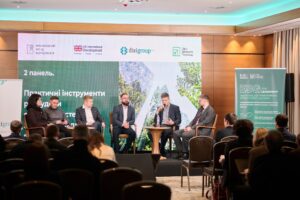
The second panel turned to the question of how green finance actually gets deployed. One third of international reconstruction funding is tied to green criteria, and the Ukrainian government already offers instruments to work within that framework — from war risk insurance premium compensation to direct support for large-scale investment projects. Through the DREAM public investment management system, all project initiators are now required to assess the climate and environmental impact of their proposals against EU Taxonomy principles. The methodology is in place and integrated into the system, but most municipalities still treat this as a formality, held back by limited experience and a shortage of quality examples. The banking sector is catching up, with the National Bank of Ukraine having set the regulatory framework and the Independent Association of Banks of Ukraine (NABU) building an ESG competence centre with templates and methodologies for the wider market. Banks are already assessing clients’ ESG risks, and the quality of data companies disclose is fast becoming a condition for access to financing.
This event was made possible with the financial support of the International Renaissance Foundation as part of the project Research and Advocacy for Ukraine’s Green Recovery Opportunities.