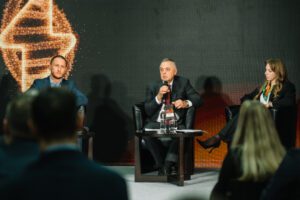
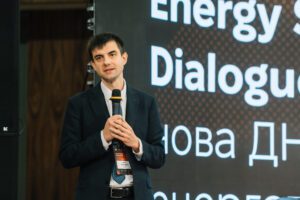
The DiXi Group think tank held its annual Ukrainian Energy Security Dialogue 2025 — the fifth discussion platform dedicated to shaping new approaches to energy security amid full-scale war, the global energy transition, intensifying hybrid threats, and growing geopolitical instability. The central question framing the event was how energy security is changing.
The event brought together leading Ukrainian and international experts, as well as representatives of the government, parliament, and business, to develop solutions that will define the future architecture of Ukraine’s and the region’s energy resilience.
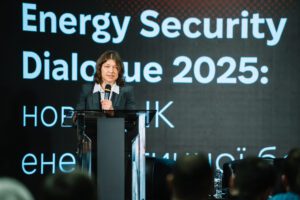
Opening the Energy Security Dialogue, DiXi Group President Olena Pavlenko emphasized that Ukraine is now shaping a new logic of energy resilience and recovery.
“While we are gradually becoming an energy-deficient country, the world is discussing where to get more energy. And since we are fighting climate change and aiming to reduce the use of fossil fuels, we will need more energy from renewables — or from nuclear generation, or from new sources like fusion. Ukraine will have to follow the same path as the EU, but twice as fast. Because we are not only building new infrastructure, but also restoring destroyed networks, clearing mined fields for new projects, and replacing transformers several times after they’ve been damaged by russian missiles and drones,” Olena Pavlenko stressed.
GLOBAL CHANGES AND LOCAL CHALLENGES: How has russia’s war transformed energy-related threats?
The first panel focused on how the full-scale war has changed the nature of threats to Ukraine’s energy sector and the region’s energy security.

Deputy Minister of Energy of Ukraine Mykola Kolisnyk emphasized that despite significant infrastructure losses, Ukraine has become an example for the world in understanding hybrid threats, managing its energy system, and rapidly diversifying both the energy sector and energy supply chains. Over two wartime winters, Ukraine’s logistics for fuel supply — and previously for natural gas and electricity — were completely rebuilt to operate through EU routes.
“Daily modernization means that every new transformer or compressor station replaces outdated Soviet equipment with modern European technology. We are moving toward a complete restructuring of the system,” Kolisnyk highlighted.
He identified the rapid growth of electricity consumption as a separate challenge. Ukraine today demonstrates one of the fastest rates of electric vehicle development in the region, but charging infrastructure, household networks, and industrial systems require substantial upgrades.
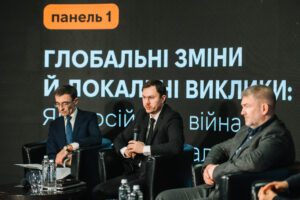
“The strategic directions that will shape energy resilience include strengthening consumer resilience through decentralized generation and storage systems, diversifying energy supply routes by developing the Poland–Ukraine–Moldova–Romania vertical corridor and fully abandoning russian gas, as well as mobilizing international support through the EU Energy Support Fund, where the Baltic States play a key role,” Kolisnyk summarized.
He also stressed that the development of interconnectors increases the flexibility and protection of the energy system against massive attacks: “When you have five entry points instead of one, the enemy doesn’t know where to strike.”
Senior Director for Energy and Critical Minerals at McLarty Associates Geoffrey Pyatt emphasized that despite political changes in the United States, American businesses maintain a strong interest in investing in Ukraine’s energy sector. He called Ukraine an example of a country that turns crisis into opportunity and is shaping a new model of the future energy system.
“Even under the most difficult circumstances, Ukraine is building a future that will be cleaner, more decentralized, resilient, and integrated into the EU energy system. American companies are interested in working here — and we are already seeing concrete examples,” Pyatt said.

He also noted that the European Union has taken a historic step by agreeing to fully abandon russian gas, with Ukraine playing a strategic role in this process.
Vitaliy Zaichenko, CEO of Ukrenergo, spoke about how the transmission system operator functions under daily attacks on the energy system and the solutions that help preserve its resilience. He highlighted that the company has implemented a physical protection program for transformer equipment that is unique in global practice.
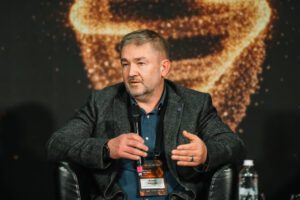
According to him, over the past two years, the energy system has fundamentally changed — both due to the war and accelerated technological development. One of the key priorities has been the program of physical anti-drone protection for equipment: more than half of autotransformers are now shielded with special concrete structures capable of withstanding strikes, direct drone hits, and missile debris. Significant emphasis has also been placed on restoration speed — today, Ukraine can replace an autotransformer in 21 days, compared to several months under peacetime European conditions.
“In parallel with restoration, we continue to plan grid development and prepare the energy system for deeper integration into the pan-European market: we are building new lines, preparing for large-scale electricity exchanges, and expanding export and import capabilities. We are engaged in dialogue with European partners on the expansion of cross-border transmission lines, as integration of the future market and electricity exchange is a challenge. That is why we are expanding opportunities for our producers and traders, accounting for the variability of renewable generation, and investing significant effort in grid development,” Zaichenko stressed.

ENERGY TRANSFORMATION: Which technologies are set to take over
The panel focused on global trends shaping the future of the energy sector: decarbonization, decentralization, digitalization, and the shift toward smart solutions. In this context, the discussion examined how Ukraine is integrating into the global energy transformation.

Roman Andarak, Deputy Minister of Energy of Ukraine, emphasized that the country’s energy system is currently operating in survival mode.
“Our main task is to maintain the availability of electricity as a basic product while laying the foundation for future green energy. We are operating in survival mode, but we must think strategically,” Andarak noted.
He stressed that the balance between rebuilding and development is shaped by three key factors: the ability to physically protect only the most critical substations; the mismatch between the pace of equipment production and the real needs of recovery; and the critical vulnerability of human capital, which the enemy deliberately targets. Funding of €1.65 billion has been secured in the Energy Support Fund.
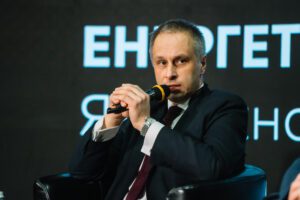
The private sector is playing an increasingly important role in reconstruction, developing renewables and flexible capacities, while the state is working to simplify grid-connection procedures and, despite limited domestic resources, continues supporting small and medium-sized businesses and households. International partners are preparing new guarantee mechanisms and risk-insurance instruments that open opportunities for large-scale recovery and resilience projects.
“The key condition for investment activity remains predictability, which must be ensured through regulatory integration with the EU. Draft law №12-087 envisages full synchronization of Ukrainian markets with European platforms by 2027. The only path to resilience is technological solutions, partnerships, and joint research. We must build a system that is not merely restored, but modernized and future-ready,” Andarak summarized.
Bohdan Sukhetskyi, Acting CEO of Ukrhydroenergo, outlined two key perspectives for the company. First, hydro and pumped-storage power plants will remain the core of balancing Ukraine’s energy system, providing the fastest and most large-scale flexibility.
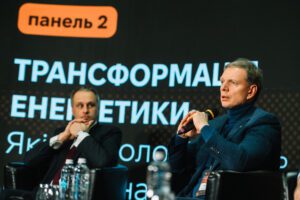
Second, the company is transforming into an integrated green platform, combining classical hydropower with energy storage, solar and wind generation, and new technologies — enabling resilience and innovation across the entire energy system.
“We see ourselves not only as an electricity producer, but as an integrated player capable of combining traditional hydropower with new green solutions and supporting future technologies, including modular nuclear energy. We are already installing energy-storage systems, expanding pumped-storage capacity, testing new technologies and hybrid solutions, and ensuring balancing, flexibility, and resilience of the energy system even under extremely challenging conditions,” he concluded.
TRANSPARENT RULES – MAJOR INVESTMENTS: Effective Tools for Strengthening Energy Security
The panel focused on practical barriers and opportunities for investment — from regulatory predictability to investment models that can function during wartime and throughout recovery. Participants discussed what is holding investors back, which signals they expect from Ukrainian regulators, and how international partners can support financing.

Andrii Gerus, Chair of the Committee on Energy and Housing and Communal Services, noted that the pace of investment in Ukraine’s energy sector is fairly strong, considering the country is at war.
“Last year, more than 800 MW of solar power plants were commissioned, and this year over 1,000 MW are expected. These estimates are based on the volume of imported panels and other equipment needed for these plants, though it is clear that installation takes place with a certain time lag,” Herus said.
By the end of next year, around 800 MW of wind power capacity and about 1,500 MW of storage systems with a total capacity of over 4,000 MWh are expected to be built. “Taken together, this dynamic looks positive. The key challenge lies in generation efficiency during winter: short and cloudy days limit solar output, and infrastructure can be destroyed faster than it can be restored,” he added.
He also noted that the state is responding to market needs. A law has been adopted introducing VAT and import-duty exemptions for energy equipment — for wind and solar power plants, energy storage systems, and gas-fired generation. The exemptions are set for three years, as one year is not enough for recovery. This also facilitates lending: banks are much more willing to finance projects when VAT is removed, enabling clients to implement larger-scale initiatives.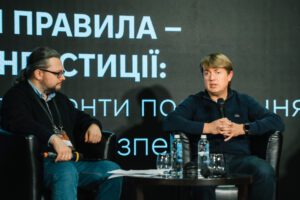
The expected adoption of a draft law on auctions for new renewable generation and expanding opportunities for active consumers to supply electricity to the grid will further support the development of generation capacities.
Silvia Martínez Romero, Lead Energy Specialist at the World Bank, outlined the structural reforms that are essential for attracting private capital to Ukraine’s energy sector. She emphasized the need to strengthen corporate governance, transparency, and accountability of state-owned enterprises; ensure the independence of the regulator and gas and transmission system operators; and gradually phase out the Public Service Obligations (PSOs).
“Market rules are important, but they do not guarantee investments if the sector is financially unstable. Without deep reforms, companies will not be able to raise the required levels of financing — whether through bonds, loans or other instruments. The World Bank is supporting with development policy operations and technical assistance Ukraine’s integration with EU energy markets, the transparency of the regulatory environment, and the development of financial instruments, including insurance and guarantee mechanisms that are critical in conditions of high uncertainty,” she stressed.
The expert also highlighted that gradual reform does not mean withdrawing support from consumers or state-owned companies but implies a shift toward fairer and more transparent approaches. She explained that the phased cancellation of PSO is not the end of assistance but a change in mechanisms that must become more equitable and clearer. According to her, full transformation is only possible step by step and with consideration of wartime conditions. Overall, the World Bank underscores that structural reforms, anti-corruption oversight, European integration, and financial transparency are the foundation for recovery and investment in the sector.

Philippe Froissard, Deputy Director of the European Commission’s “Clean Planet” Directorate, noted that research and innovation are key to strengthening the resilience of the energy sector and enhancing its investment attractiveness. The Horizon Europe and Euratom programmes enable Ukrainian companies and research institutions to test new technologies, reduce risks, and align with European standards and markets — supporting both the energy transition and the country’s recovery.
He emphasized that Horizon Europe is the largest research and innovation programme in the world, with a budget of $95 billion.
“Ukraine is fully associated with Horizon Europe, which means that any university, company, or startup can participate in all areas of the programme on equal footing with EU member states,” Froissard stressed.
He highlighted that Horizon Europe has already provided more than €63 million to Ukrainian participants, and the 2026–2027 work programme includes more than $200 million for projects aimed at supporting Ukraine. This creates significant opportunities for piloting technologies, developing standards, and integrating Ukrainian innovations into European markets.




The event was supported by the International Renaissance Foundation, the Konrad Adenauer Foundation, the Ministry of Energy of Ukraine, and information partners — the Energy Community, Kyiv Independent, the TV channel “We Are Ukraine,” and Ukrainian Radio.