
On June 22, 2026, the World Bank’s Board of Directors approved a new Development Policy Operation (DPO-1 2026) in the amount of USD 3.39 bn: USD 1.0 bn of which is a DPO loan and USD 2.35 bn is an additional grant. A number of other conditions and commitments were defined that will enable Ukraine to receive assistance under DPO-2.
Ukraine and the IMF have reached a staff-level agreement on the first review of the programme. The agreement must be approved by the IMF Executive Board, which will consider it in July. It should be noted that, based on the mission’s findings, IMF experts stated that “all quantitative performance criteria and indicative targets as of the end of March were met, while progress on structural reforms has slowed.”
Ukraine received the seventh tranche of funding from the EU under the Ukraine Facility in the amount of EUR 2.75 bn thanks to the flexibility of the methodology on calculation of payment instalments. However, Ukraine’s backlog in meeting the indicators under Ukraine Plan is growing, and the Plan has become even more ambitious due to the introduction of new indicators required to receive funding under the Ukraine Support Loan within the Ukraine Facility.
On June 25, Ukraine received EUR 3.2 bn from the EU under the Ukraine Support Loan as part of the macro-financial assistance program. On June 30, EUR 3.9 bn from the EU were transferred to a special fund of the Ukrainian State Budget: the first disbursement under the first defense tranche of 5.01 bn euros under the Ukraine Support Loan program.
Requirements for Receiving Assistance from the World Bank
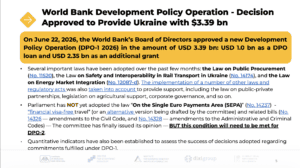
Obligations necessary to receive the DPO-2 aid tranche were defined
- Adopt sub-legislation for Law No. 4510-IX on public-private partnerships and concessions
- Adopt implementing regulations or subsequent legislative amendments to implement Laws No. 4466-IX and No. 4622-IX on factoring and the National Development Institution
- Adopt legislative amendments regarding investment funds and the valuation of assets and companies
- Enact legislation that will allow Ukraine to join SEPA
- Announce a privatization tender for at least one state-owned bank
- Adopt legislation that simplifies privatization procedures, in particular by expanding small-scale privatization
- Implement the key findings of the independent assessment of corporate governance at state-owned enterprises, expand annual reporting on corporate governance systems, and strengthen supervisory boards
- Adopt legislation on covered bonds and securitization to support long-term financing, including mortgages
- Adopt secondary legislation on a new funding model for vocational education institutions
- Approve regulations defining the status and requirements for the external audit of the agricultural payment agency
- Adopt and enact regulations to implement Law No. 4834-IX on day-ahead and intraday electricity markets, designated electricity market operators, risk preparedness, and crisis prevention and management in the electricity sector
IMF
IMF Program: Programme Review Despite Delays
On June 12, the IMF and Ukraine reached a staff-level agreement on the first review of the EFF program
despite the failure to meet the first benchmark and the delayed fulfillment of two others
Once the decision is approved by the IMF Executive Board, Ukraine will gain access to approximately $690 m (out of $2.2 bn under the entire EFF).
The meeting is expected to take place by mid-July
The review also includes “corrective actions” and new commitments
simplification of tax administration, risk-based audits, institutional changes at the the Bureau of Economic Security and Customs , and the independence of the NEURC
Unfulfilled commitments are piling up
The IMF has agreed to extend the deadlines for eliminating tax exemptions on parcels (to the end of July) and introducing VAT for sole proprietors (postponed by one year).
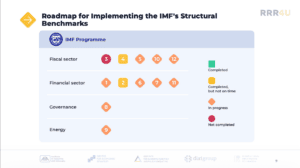
Among the unmet Benchmarks as of the end of June:
- draft law on transfer pricing -> not submitted to the Verkhovna Rada (No. 5)
- strategy for state-owned banks -> not approved (No. 6)
- oversight of risks posed by critical third parties -> not implemented (No. 7)
- Regulations from the National Agency for Corruption Prevention (NACP) regarding a risk-based system for verifying declarations -> none (No. 8)
EU
Ukraine Plan: Funds are coming in, but unmet commitments are piling up
- Ukraine received the 7th regular payment from the EU under the Ukraine Facility, totaling EUR 2.75 bn, thanks to the flexibility of the methodology on payment instalments.
- However, the commitment arrears in meeting the indicators under the Ukraine Plan is growing, and the Plan has become even more ambitious:
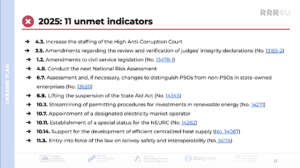
- 11 indicators for 2025 have not been met
- 5 indicators for Q1 2026 have not been met
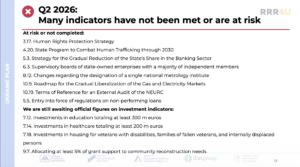
- 13 indicators for Q2 2026 are in progress (but it is highly likely that some will be marked as “not completed”)
- The government has introduced amendments to the Ukraine Plan, which have already been approved by the European Commission, increasing the number of new indicators required to receive funding under the Ukraine Support Loan within the Ukraine Facility.
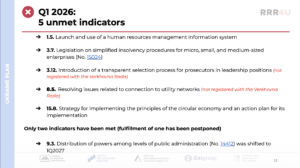
Ukraine’s Plan has been updated: Even more ambitious than before
Changes have been made to Ukraine’s Plan to secure EUR 8.35 bn under the Ukraine Facility as part of the Ukraine Support Loan in 2026
- Update: 35 existing steps are to be revised (deadline changes, clarification of wording)
- Additions: 26 new indicators (10 legislative and 16 government decisions).
- 6 indicators were added for the Q2 2026 – most are unmet or at risk
- 5 indicators were added for the third quarter, and 15 for the fourth quarter of 2026
- Indicators for 2027 will be determined later
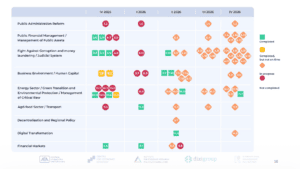
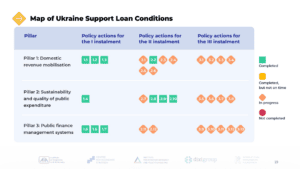
Monitoring of Macro-Financial Assistance: Ukraine Support Loan
Ukraine Support Loan: Macro-Financial Assistance Component
- On June 25, Ukraine received EUR 3.2 bn from the EU as part of the Ukraine Support Loan under the macro-financial assistance program (a total of EUR 8.35 bn is expected by 2026).
- This was facilitated by the fulfillment of relatively straightforward conditions for the first tranche (although a new draft law on the taxation of parcels has not yet been introduced).
- Four of the 12 conditions required to receive the second tranche of assistance have been met: the PFM IT concept, the Budget Declaration, taxation of digital platform revenues, and expenditure reviews. At the same time, work on some of the more complex conditions has not yet begun.
- On June 30, the special fund of the State Budget of Ukraine received EUR 3.9 bn from the EU: the first payment under the first defense tranche of EUR 5.01 bn as part of the Ukraine Support Loan program.
SPECIAL TOPIC — «Anti-Corruption Strategy 2026–2030: Challenges and Expectations for Reforms»
You can view the previous monitors on the website RRR4U
The monitoring was prepared with the support of the International Renaissance Foundation.
RRR4U (Resilience, Reconstruction and Relief for Ukraine) is a consortium of four Ukrainian civil society organisations: Centre for Economic Strategy, Institute for Economic Research and Policy Consulting, Institute of Analytics and Advocacy and DiXi Group.